Key takeaways
- Compare the best industrial miter saws for production shops: 15-amp motors, wide crosscut capacity, and detent plates that hold angles through long runs.
A miter saw on a production floor earns its keep differently from a saw in a home garage. It runs for full shifts, cuts the same angles hundreds of times a week, and gets bolted to a fixed station where accuracy drift costs real money in rework and wasted stock. The saws that suit that work share a few traits: a full 15-amp corded motor with enough torque to pull through dense hardwood without bogging down, a heavy cast base and fence system that stay put under repeated clamping, and a detent plate that returns to the common angles with a positive, repeatable lock rather than a friction guess.


This guide looks at five 12-inch saws through that production lens. Two are fixed-head compound saws built for dedicated cutting stations, and three are wide-capacity sliders for shops that crosscut shelving, panel parts, and wide casing all day. Every model here is a current production machine from a major maker, with published specifications drawn from the manufacturer or the Amazon listing data for that exact model.
As an Amazon Associate, we earn from qualifying purchases.
Quick answer
For most production shops, the DEWALT DWS716 is the anchor pick: a fixed-head, double-bevel 12-inch saw with a 15-amp motor, a stainless detent plate with 14 positive stops, and tall fences that support 6-1/2-inch base molding upright. If your cut list runs wider, the Makita LS1219L adds a 15-inch crosscut and a direct-drive motor with no belts to service.
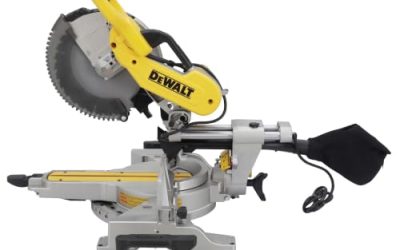
DEWALT DWS716 12-Inch Double-Bevel Compound Miter Saw
The DWS716 is the classic dedicated-station saw, and its fixed head is exactly why it suits production work. With no slide rails to wear, deflect, or collect packed dust, the head travels one short, rigid path, which helps the saw hold its settings through long runs of identical cuts. Cabinet shops and trim plants bolt these down, dial in a stop block, and cut casing, face-frame stock, and framing lumber to length all week.
The 15-amp motor turns the 12-inch blade at 3,800 RPM, and the head bevels 0 to 48 degrees in both directions, so operators can cut compound angles without flipping long stock end for end. The stainless-steel miter detent plate carries 14 positive stops, and a cam-lock handle lets the operator override a detent and lock down a custom angle when a job calls for one. Tall sliding fences support base molding up to 6-1/2 inches tall held vertically and crown molding up to 6-5/8 inches nested, which covers the bulk of architectural millwork a production trim line sees.
Capacity is the honest trade-off. As a non-sliding saw, crosscut width tops out at a 2×8 at 90 degrees and a 2×6 at 45 degrees, so wide shelving boards belong on one of the sliders below. Within that envelope, though, the DWS716 is a durable, predictable machine with a three-year limited warranty behind it.
Key specs
- Motor: 15 amp, 3,800 RPM no-load
- Blade: 12 inch
- Bevel range: 0 to 48 degrees, left and right, with stops at 0, 22.5, 33.9, and 45 degrees
- Miter range: 0 to 50 degrees, left and right, 14 positive stops
- Crosscut capacity: 2×8 at 90 degrees, 2×6 at 45 degrees
- Vertical capacity: 6-1/2 inch base molding, 6-5/8 inch crown nested
- Weight: 41 lb
- Warranty: 3-year limited
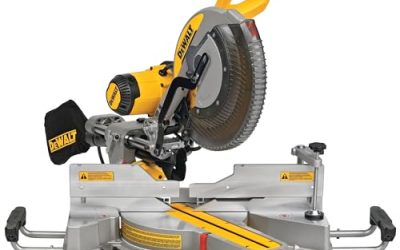
Makita LS1219L 12-Inch Dual-Bevel Sliding Compound Miter Saw
The LS1219L is the wide-capacity pick for shops whose cut lists include shelving, stair parts, and panel components too wide for a fixed-head saw. Its sliding system crosscuts up to 15 inches at 90 degrees and handles a 4×14 in a single pass, with vertical capacity for 6-3/4-inch baseboard and 8-inch crown molding nested. That is genuine production capacity, not a homeowner slider stretched thin.
The drive system is the other production argument. Makita uses a 15-amp direct-drive motor turning at 3,200 RPM, with the gearbox driving the blade directly. There are no belts to tension, slip, or replace on a maintenance schedule, and electronic speed control holds blade speed steady as the cut loads up. A soft-engagement ramp and an electric brake round out a drive package designed for stop-and-go batch cutting all day.
Makita’s two-steel-rail layout also matters on a crowded floor: the rails stay within the saw’s footprint, so the station can sit flush against a wall instead of needing deep clearance behind it. The miter range runs 0 to 60 degrees both ways with positive stops at the six common angles, and the bevel range covers 0 to 48 degrees left and right. At 65 lb it is a bolt-it-down machine, and a built-in laser marks the cut line for fast alignment on repeat parts.
Key specs
- Motor: 15 amp direct drive, 3,200 RPM no-load
- Blade: 12 inch, 1-inch arbor
- Bevel range: 0 to 48 degrees, left and right
- Miter range: 0 to 60 degrees, left and right, stops at 0, 15, 22.5, 31.6, 45, and 60 degrees
- Crosscut capacity: 3-5/8 x 15 inches at 90 degrees, 4×14 lumber in one pass
- Vertical capacity: 6-3/4 inch baseboard, 8 inch crown nested
- Weight: 65 lb
Bosch GCM12SD 12-Inch Dual-Bevel Glide Miter Saw

Bosch took a different mechanical route with the GCM12SD. Instead of rails, its Axial-Glide arm folds the cutting head forward on a sealed, articulated linkage. For a production station, that design has two practical payoffs: the glide action stays smooth and play-free over a long service life because there are no exposed rail bearings to pack with dust, and the saw needs no rear clearance, so it can sit tight to a wall or a dust hood at the back of a bench line.
The 15-amp motor runs at 3,800 RPM, and capacity is broad: a 3-1/2 x 13-1/2 inch crosscut at 90 degrees, which covers 2×14 dimensional lumber, plus 6-1/2 inches of vertical capacity against the fence. The miter range is asymmetric in a useful way, running 52 degrees left and 60 degrees right, while the bevel range covers 47 degrees in both directions with stops at 0, 33.9, and 45 degrees. Those 33.9-degree bevel and 31.6-degree miter stops match the flat-cut settings for common crown spring angles, which speeds up millwork changeovers.
All major controls sit up front, so an operator changing angles between batches does not reach around the blade. At 65 lb, the GCM12SD is firmly a fixed-station saw. Bosch backs it with a one-year limited warranty, the shortest coverage in this group, which is worth weighing if your shop runs multiple shifts.
Key specs
- Motor: 15 amp, 3,800 RPM no-load
- Blade: 12 inch
- Bevel range: 0 to 47 degrees, left and right
- Miter range: 52 degrees left, 60 degrees right
- Crosscut capacity: 3-1/2 x 13-1/2 inches at 90 degrees, 2×14 lumber class
- Vertical capacity: 6-1/2 inches against the fence
- Weight: 65 lb
- Warranty: 1-year limited
Metabo HPT C12RSH3 12-Inch Dual-Bevel Sliding Miter Saw

The C12RSH3 is the value-leaning slider in this lineup, but its production credentials are real, beginning with the warranty: Metabo HPT covers the saw for five years, the longest term here, which matters when a machine is a line asset rather than a personal tool. The 15-amp motor spins up to 4,000 RPM, the fastest no-load speed in this group, and the sliding head gives the saw crosscut reach well beyond the fixed-head models for wide casing and shelving stock.
Angle changes are built for pace. One-touch miter and bevel locks let an operator swing to a new setting and clamp it in a single motion, and the miter scale is adjustable so the saw can be trued back to the gauge during scheduled calibration. The miter range runs 0 to 45 degrees left and 0 to 57 degrees right, with nine detent stops, and the head bevels 45 degrees in both directions.
Instead of a laser, the C12RSH3 uses an Xact Cut shadow line: an LED casts the blade’s own shadow onto the work, showing the true kerf width in any shop lighting with nothing to align or drift. For repeat cutting under bright industrial lights, that is a genuinely practical system. At 53.6 lb, it is the lightest slider here, though in a production setting it still belongs on a fixed bench or stand.
Key specs
- Motor: 15 amp, 4,000 RPM no-load
- Blade: 12 inch
- Bevel range: 0 to 45 degrees, left and right
- Miter range: 0 to 45 degrees left, 0 to 57 degrees right, 9 detent stops
- Cut line: Xact Cut LED shadow line
- Weight: 53.6 lb
- Warranty: 5-year
DEWALT DWS715 12-Inch Single-Bevel Compound Miter Saw

Not every station on a production floor needs double-bevel range. Plenty of lines run one bevel direction all day: a casing cell set up for left-hand miters, a framing cutoff station, or a second saw dedicated to square and 45-degree work so the main saw keeps its compound setup. The DWS715 is built for exactly that supporting role, and it shares its core platform with the DWS716.
It runs the same class of 15-amp motor at a slightly higher 4,000 RPM, the same stainless detent plate with 14 positive stops, and the same 0 to 50 degree miter range in both directions. Crosscut capacity matches its sibling at a 2×8 at 90 degrees and a 2×6 at 45 degrees. The differences are the bevel head, which tilts 0 to 48 degrees to the left with only a small 0 to 3 degree allowance to the right, and shorter fences that support 5-1/2-inch base molding vertically and 5-1/4-inch crown nested.
At 36 lb, it is the lightest saw here, so a two-person crew can move it between cells without a cart. DEWALT covers it with a three-year limited warranty and one year of free service. Shops that genuinely cut bevels in both directions all shift should step up to the DWS716; shops adding a dependable second station will find the DWS715 covers the work for less money tied up per station.
Key specs
- Motor: 15 amp, 4,000 RPM no-load
- Blade: 12 inch
- Bevel range: 0 to 48 degrees left, 0 to 3 degrees right
- Miter range: 0 to 50 degrees, left and right, 14 positive stops
- Crosscut capacity: 2×8 at 90 degrees, 2×6 at 45 degrees
- Vertical capacity: 5-1/2 inch base molding, 5-1/4 inch crown nested
- Weight: 36 lb
- Warranty: 3-year limited with 1-year free service
How to choose
Begin with the widest stock on your regular cut list, because that single number decides the saw class. If everything stays within a 2×8 envelope, a fixed-head compound saw like the DWS716 or DWS715 gives you the most rigid, repeatable platform per station. If wide shelving, stair treads, or panel parts are routine, budget for a slider or glide saw and accept the extra maintenance that moving rails or arms require.
Next, match the bevel setup to the work. Double-bevel heads pay off when operators cut compound angles on long stock that is awkward to flip; single-bevel saws are fine for one-direction lines and second stations. Then look at the detent system: a machined or stainless plate with positive stops at your common angles, plus a lock that can override the detents for in-between angles, is what keeps the fiftieth cut of the morning identical to the first.
Finally, plan the station, not just the saw. Bolt the saw to a level bench or stand, add infeed and outfeed support at fence height, fit a stop block system for repeat lengths, and connect dust extraction sized for a 12-inch blade running all day. Check the maker’s warranty term and parts availability too, since a production saw is a long-term asset; the five-year coverage on the Metabo HPT and the three-year DEWALT terms are part of the value calculation, not fine print.
Who should skip
Homeowners and occasional DIY users should skip this class entirely. A 10-inch saw or a lighter 12-inch consumer model will handle weekend trim work at lower cost, and none of the weight, capacity, or duty-cycle engineering here will matter for a few dozen cuts a month. Contractors who carry a saw to a different site every day should also look elsewhere: at 36 to 65 lb, these are bench and station machines, and compact jobsite saws with folding stands exist for that life. Finally, shops whose main work is metal cutting need a dedicated cold-cut or abrasive machine with the right blade, guarding, and speed range; none of these wood-cutting saws is the correct tool for that line.
Frequently Asked Questions
What separates an industrial miter saw from a homeowner model?
Duty cycle and repeatability. Industrial-class saws use full 15-amp motors, heavy cast bases, tall fences, and machined detent plates designed to return to the same angle thousands of times. They are built to be bolted down, run for full shifts, and hold calibration, while homeowner models trade that mass and durability for low weight and low cost.
Is a sliding saw or a fixed compound saw better for production work?
It depends on stock width. A fixed-head saw has fewer moving parts, stays in calibration longer, and is the better choice when every part fits its crosscut envelope. A sliding or glide saw earns its place when wide boards are routine, but its rails or arm add a maintenance item and one more source of play to check on a schedule.
How much crosscut capacity does a production shop actually need?
Measure the widest part on your regular cut list, not the widest board you might see once a year. Trim and casing lines rarely need more than a 2×8 envelope, which fixed-head saws cover. Shelving, stair, and panel work pushes into 12 to 15 inches of crosscut, which is slider territory. Oversizing beyond that adds cost, footprint, and blade deflection risk for no benefit.
How often should detents and fences be checked in a high-volume shop?
A sensible rhythm is a quick square check against a known-good reference at the beginning of each shift, and a full calibration of the miter scale, bevel stops, and fence alignment on a monthly schedule, or immediately after the saw is moved or bumped hard. Detent plates wear gradually, so catching drift early is what keeps a whole batch from drifting with it.
Final verdict
For a single production station, buy the DEWALT DWS716: its fixed head, stainless detent plate, and tall fences make it the most repeatable saw here for trim, casing, and framing stock. Add the Makita LS1219L where the cut list runs wide, since its direct-drive motor and 15-inch crosscut are built for batch work. The Bosch GCM12SD suits wall-tight stations, the Metabo HPT C12RSH3 brings the longest warranty and a fast changeover setup, and the DWS715 is the sensible second saw for one-direction lines. Match the machine to the cut list, bolt it down, and any of these five will hold angles through long production runs.
Product and ASIN Reference
| Product | ASIN |
|---|---|
| DEWALT DWS716 12-Inch Double-Bevel Compound Miter Saw | B07P6GW996 |
| Makita LS1219L 12-Inch Dual-Bevel Sliding Compound Miter Saw | B07B3WF2Y2 |
| Bosch GCM12SD 12-Inch Dual-Bevel Glide Miter Saw | B004323NNC |
| Metabo HPT C12RSH3 12-Inch Dual-Bevel Sliding Miter Saw | B0CY6R4MHX |
| DEWALT DWS715 12-Inch Single-Bevel Compound Miter Saw | B07P8QTFRC |