Key takeaways
- Compare four budget table saws for home workshops, from a compact benchtop model to a full-size rolling-stand saw, and find the right fit for your work.
Shopping for a table saw on a tight budget comes down to trade-offs. The lowest-cost saw will cut wood, but the real decision is whether its fence stays square, its motor keeps turning through hardwood, and its rip capacity covers the boards you actually cut. A saw that drifts out of alignment or stalls mid-rip turns every project into a fight. The four saws below sit in the budget end of the market, each handling a different kind of home work well.

This guide is for first-time buyers setting up a small garage shop, renters who need a saw that folds away, and DIYers building shelves, furniture, and trim themselves. The products were chosen from the names and specifications on their Amazon listings, focusing on blade size, rip capacity, motor strength, and the stand in the box. Read the buying advice first, then match one of the four saws to your work.
Quick Picks
As an Amazon Associate we earn from qualifying purchases
| Product | Best for | Key spec from title |
|---|---|---|
| SKIL 15 Amp 10 Inch Portable Jobsite Table Saw with Folding Stand – TS6307-00 | Full-size cutting on a modest budget | 10-inch blade with 25-1/2-inch rip capacity |
| DEWALT 15 Amp 8-1/4 in. Compact Portable Jobsite Table Saw – DWE7485 | Small shops and easy carrying | 8-1/4-inch blade with 24-1/2-inch rip capacity |
| DEWALT 10 Inch Table Saw with Rolling Stand – DWE7491RS | Wide sheet goods and shelving | 10-inch blade with 32-1/2-inch rip capacity |
| WEN TT0811 11-Amp 8.25-Inch Compact Benchtop Jobsite Table Saw | Occasional small projects and tight storage | 8.25-inch blade with 25-inch rip capacity |
How to Choose
Blade Size and Cutting Depth
Blade size decides how deep a saw can cut in a single pass. A 10-inch blade typically cuts a little over three inches deep at a straight ninety-degree angle, which covers common framing lumber and four-by-four posts on some models. An 8-1/4-inch blade cuts a little over two and a half inches deep, handling plywood, shelving, and two-by framing lumber, but leaving thicker stock to be flipped and cut from the other side. Before choosing, list the thickest material you expect to cut and check the depth of cut at ninety degrees and at forty-five degrees, since a bevelled cut is always shallower. A smaller blade is fine until the work regularly exceeds its reach.
Rip Capacity and the Fence
Rip capacity is the distance from the blade to the fence, setting the widest board you can rip. With twenty-four or twenty-five inches of rip capacity, a saw can split a sheet of plywood in one pass, a useful benchmark for shelving and cabinet work. The fence matters just as much, because a fence that flexes or drifts means every rip comes out a different width. Rack-and-pinion fences move smoothly and lock parallel to the blade, which is why they appear on three of the four saws here. When you set up a new saw, check the fence against the blade with a square, lock it, and recheck it after a few cuts.
Motor Power and Blade Speed
Most budget jobsite saws run on a standard household circuit with a 15-amp motor, enough for plywood, pine, and most hardwoods with a sharp blade. The WEN model here uses an 11-amp motor instead, suiting lighter work and thinner stock but bogging down sooner in dense hardwood. Blade speed, listed as no-load RPM, is how fast the blade spins before it meets wood. Higher speed generally gives a cleaner cut in sheet goods and trim, while a slower, larger blade leans on torque for thick rips. Neither number guarantees a good cut: a dull blade on a strong motor still burns wood, while a sharp blade on a modest motor cuts cleanly at a steady feed rate.
Stand, Weight, and Safety Features
A table saw is only useful if it sets up and stores easily. Folding and rolling stands let one person move a heavy saw, while a benchtop saw needs a sturdy bench or a separate stand for a comfortable height. Weight is the other side of it: a saw near forty pounds carries easily up a flight of stairs, while one near ninety pounds with its stand is a rolling job. Safety features deserve the same attention as cutting specs: look for a blade guard, a riving knife, and anti-kickback pawls, and keep them fitted during cuts. Use the supplied push stick, keep hands clear of the blade, and unplug the saw before changing a blade or clearing a jam.
The 4 Best Options
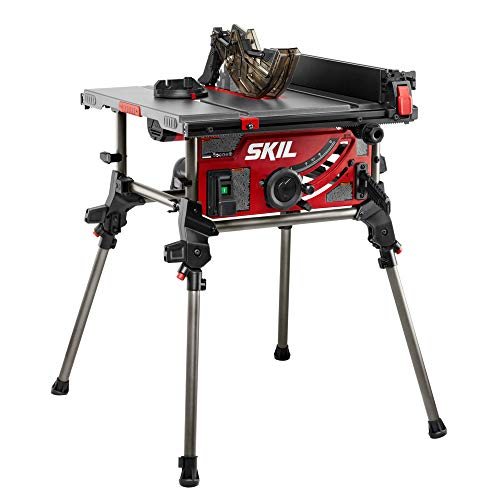
SKIL 15 Amp 10 Inch Portable Jobsite Table Saw with Folding Stand – TS6307-00
The SKIL TS6307-00 is the most complete full-size saw in this group, and it suits a buyer who wants ten-inch cutting capacity without stepping up to a larger workshop machine. Its folding legs form an integrated stand, so the saw is ready to use on a driveway or garage floor and folds flat for storage against a wall. The rack-and-pinion fence rails adjust smoothly and stay parallel to the blade, which is the feature that separates a disappointing budget saw from a useful one. It cuts four-by-four material at ninety degrees, handling fence posts, deck framing, and furniture legs that smaller saws cannot finish in one pass.
Specs
- 15-amp motor, 120 volts, corded electric
- 10-inch blade with 24 teeth, carbide tipped
- No-load speed of 4,600 RPM
- Rip capacity of 25-1/2 inches to the right of the blade and 14 inches to the left
- Maximum cutting depth of 3-1/2 inches at 90 degrees and 2-1/2 inches at 45 degrees
- Bevel capacity of -2 to 47 degrees with stops at 0 and 45 degrees
- Cuts material up to 4×4 at 90 degrees
- Rack-and-pinion fence rails with parallel blade alignment
- Integrated folding stand and dust port elbow
- Item weight of 51.2 pounds
Best for: Home woodworkers who want a full-size ten-inch saw with a stand included and room to rip sheet goods.
Watch out for: Check the fence alignment and the bevel stops before the first project, and confirm the folding legs lock firmly in the open position.
DEWALT 15 Amp 8-1/4 in. Compact Portable Jobsite Table Saw – DWE7485
The DEWALT DWE7485 is the compact pick for a small shop, suiting a buyer who values portability and a fence that holds its setting over maximum cutting depth. Its smaller 8-1/4-inch blade spins at 5,800 RPM for clean cuts in plywood and trim, and its rack-and-pinion fence reaches 24-1/2 inches to the right of the blade, enough to split a sheet of plywood in half. The saw carries to a job, sets on a bench, and packs away without the bulk of a rolling stand. The trade-off is depth: thick stock needs a second pass, so this saw fits shelving, cabinet parts, flooring, and trim better than heavy framing.
Specs
- 15-amp motor, 120 volts, corded electric
- 8-1/4-inch blade with 24 teeth
- No-load speed of 5,800 RPM
- Rip capacity of 24-1/2 inches to the right of the blade and 12 inches to the left
- Maximum depth of cut of 2-9/16 inches at 90 degrees and 1-3/4 inches at 45 degrees
- Maximum bevel of 45 degrees
- Rack-and-pinion fence system
- Arbor size of 5/8 inch
- Dust port diameter of 2-1/4 inches
- Includes miter gauge, push stick, riving knife, anti-kickback pawls, and modular guard system
Best for: Small garages and shared workspaces where the saw must be carried, stored, and set up again often.
Watch out for: Measure the thickest stock you plan to cut against the 2-9/16-inch depth limit, and remember that no separate stand is included with the saw alone.
DEWALT 10 Inch Table Saw with Rolling Stand – DWE7491RS
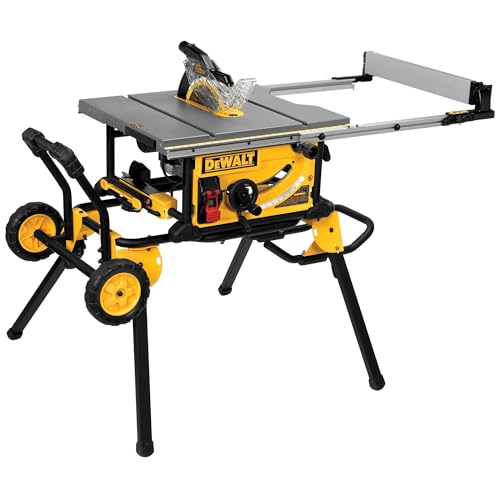
The DEWALT DWE7491RS is the widest-cutting saw in this guide, and it suits a buyer who regularly rips sheet goods, wide shelving, and long trim. Its 32-1/2-inch rip capacity is the largest here by a clear margin, and the rack-and-pinion telescoping fence keeps that wide fence square while it slides. The rolling stand has wheels and a kickstand, so the saw moves across a garage or driveway without lifting, and it folds for storage when the work is done. A ten-inch blade cutting 3-1/8 inches deep at ninety degrees handles thick boards that compact saws cannot, which makes this the pick for cabinet work and larger home projects.
Specs
- 15-amp motor, 120 volts, corded electric
- 10-inch blade with 24 teeth, carbide tipped
- No-load speed of 4,800 RPM
- Rip capacity of 32-1/2 inches to the right of the blade and 22 inches to the left
- Maximum depth of cut of 3-1/8 inches at 90 degrees and 2-1/4 inches at 45 degrees
- Maximum bevel of 45 degrees
- Rack-and-pinion telescoping fence with flip-over narrow-rip support
- Rolling stand with wheels and kickstand
- Dust port diameter of 2-1/2 inches
- Arbor size of 5/8 inch
- Table size of 26-3/8 by 21-7/8 inches
- Weight with stand of 90 pounds
Best for: Home shops and garages where wide sheet goods, shelving, and cabinet parts are cut on a regular basis.
Watch out for: The saw with its stand is heavy and needs floor space to roll and fold, so measure doorways and storage space before ordering.
WEN TT0811 11-Amp 8.25-Inch Compact Benchtop Jobsite Table Saw

The WEN TT0811 is the smallest and lightest saw in this guide, suiting a buyer who needs a table saw for occasional projects and has very little room to spare. At 37.6 pounds it lifts onto a bench easily, and its 25-inch rip capacity is generous for a saw of this size, covering plywood, shelving, and craft boards. The 11-amp motor is the least powerful here, so it belongs on lighter work: pine, plywood, and thin hardwood, fed steadily with a sharp blade. For a first saw in a small apartment workshop, or a second saw for quick cuts, it covers the basics without taking over the room.
Specs
- 11-amp motor, corded electric
- 8.25-inch blade
- No-load speed of 4,500 RPM
- Rip capacity of 25 inches to the right of the blade
- Maximum depth of cut of 2.75 inches at 90 degrees
- Item weight of 37.6 pounds
- Compact benchtop design for use on a workbench
Best for: Occasional home projects, craft work, and workshops where storage space is the deciding factor.
Watch out for: The saw needs a sturdy bench or separate stand to reach a comfortable working height, and dense hardwood may need slower feeding than on the 15-amp models.
Which One Fits Your Situation
First Table Saw for a Small Garage
Choose the SKIL TS6307-00. It gives you a full ten-inch blade, a folding stand, and enough rip capacity for sheet goods, which covers the widest range of first projects without demanding a permanent footprint. A beginner learns ripping, crosscutting, and bevel cuts on one machine, and the stand folds away when the garage needs its space back. The DEWALT DWE7485 is the fallback if carrying weight matters more than cutting depth.
Ripping Sheet Goods and Wide Shelving
Choose the DEWALT DWE7491RS. Its 32-1/2-inch rip capacity handles wide shelving and cabinet panels that the other saws cannot reach, and the rolling stand supports the saw while long boards pass through. The telescoping fence stays square across that wide range, which keeps repeated rips the same width. If your work is mostly narrow trim and small parts, the extra rip capacity adds bulk you may not need.
Carrying the Saw to Different Jobs
Choose the DEWALT DWE7485. It is the most portable of the 15-amp models here, with a compact body, a fast-spinning blade, and a fence that still rips a sheet of plywood in half. It sets up on a bench or a tailgate and packs into a vehicle without a stand to wrestle. The WEN TT0811 is lighter still, but its 11-amp motor is better kept for lighter work at home than for varied jobsite material.
Occasional Small Projects on a Tight Budget
Choose the WEN TT0811. It is the lightest saw in this guide and the simplest to store, and its 25-inch rip capacity covers the plywood and shelving boards that most occasional projects need. Feed boards steadily, keep the blade sharp, and stay within its depth limit, and it handles craft work, small furniture, and home repairs. If the projects grow into regular hardwood work, step up to the SKIL or one of the DEWALT models instead.
Common Mistakes
- Buying on blade size alone: a ten-inch blade does not help if the fence drifts or the rip capacity is too narrow for your boards, so check fence design and rip width first.
- Ignoring the depth limit: an 8-1/4-inch blade cannot finish thick stock in one pass, and flipping a board to cut from both sides leaves a ridge unless the two cuts line up exactly.
- Removing the guard and riving knife for convenience: these parts guard against kickback, and a saw without them is far more likely to throw a board back at the operator.
- Forgetting the stand: a benchtop saw still needs a stable bench or a separate stand at a comfortable height, and a rolling-stand saw still needs floor space to fold and store.
- Skipping dust collection: table saws throw a large volume of fine dust, so connect a vacuum or a dust bag to the dust port and wear eye and hearing protection on every cut.
Frequently Asked Questions
What size table saw blade do most home woodworkers need?
A ten-inch blade suits most home woodworkers because it cuts a little over three inches deep and accepts the widest range of replacement blades. An 8-1/4-inch blade suits small shops and portable use, since it still rips sheet goods and cuts shelving and trim cleanly. Choose the ten-inch size if you cut thick lumber often, and the smaller size if portability and storage matter more than depth.
Can a compact jobsite saw cut through thick hardwood?
A compact jobsite saw can cut hardwood, but it needs a sharp blade, a steady feed rate, and realistic expectations about thickness. The 15-amp models here handle hardwood boards within their depth limits when the blade is clean and the fence is square. The 11-amp WEN model is better kept to thinner stock and softer woods. Forcing a board through a struggling blade burns the wood and strains the motor.
Do I need a stand with my table saw?
A stand is needed in one form or another, because a table saw must sit at a stable, comfortable height to cut safely. The SKIL and the DEWALT DWE7491RS include stands, while the DEWALT DWE7485 and the WEN TT0811 are benchtop models that need a sturdy bench or a separate stand. Check what is included before ordering, and measure the space where the saw will be stored.
What should I check before the first cut?
Check the fence against the blade with a square, confirm the blade is tight and the guard and riving knife are in place, and check the bevel stops at zero and forty-five degrees. Run the saw without wood to check for vibration, then test-rip scrap and measure it. Keep the push stick close by, stand to the side of the blade, and unplug the saw before any adjustment.