Key takeaways
- Compare the 4 best 12-inch sliding compound miter saws for November 2026. Cut capacity, bevel range, and key specs to help you choose the right saw.
A 12-inch sliding compound miter saw is the tool that turns wide boards and tall crown molding from a struggle into a single clean pass. The sliding rails extend the crosscut far beyond what a fixed-head saw can manage, while the compound head tilts both ways for bevel cuts without flipping the workpiece. Choosing the wrong one usually means living with a saw that cannot reach across a wide board, drifts out of square, or eats up too much bench space. The right choice depends on the size of material you cut most, how often the saw moves, and how much room you have behind it.


This guide covers four saws chosen from Amazon listing names and specifications: the DEWALT DWS779, the Makita LS1219L, the Bosch GCM12SD, and the Metabo HPT C12RSH2. They serve trim carpenters who cut crown molding all day, framers who need wide crosscuts in dimensional lumber, furniture makers who want repeatable accuracy, and serious home woodworkers setting up a first dedicated miter station. Each saw below is a 12-inch dual-bevel sliding compound model with a 15-amp motor, so the differences come down to slide design, bevel range, and the details that matter on the job.
Quick Picks
As an Amazon Associate we earn from qualifying purchases.
| Product | Best for | Key spec from title |
|---|---|---|
| DEWALT DWS779 | Wide crosscuts in dimensional lumber | 15-amp motor with 3,800 RPM no-load speed |
| Makita LS1219L | Tight workshops and flush-to-wall setups | Dual-steel rail slide system with laser |
| Bosch GCM12SD | Smooth glide in a compact footprint | Axial-Glide system with 15-amp motor |
| Metabo HPT C12RSH2 | Trim work with laser guidance | 15-amp motor with laser marker |
How to Choose
Cut Capacity
Cut capacity decides whether a saw handles your material in one pass or forces a flip-and-finish cut that rarely lines up perfectly. A 12-inch sliding saw should crosscut wide boards at 90 degrees and still reach across a 2-by-10 at a 45-degree miter. Check the maximum crosscut at 90 degrees, the crosscut at 45 degrees, and the maximum cutting height for tall baseboard and crown molding stood on edge. If most of your work is shelving and wide planks, prioritize crosscut width. If you cut a lot of tall trim, prioritize vertical cutting height and a fence tall enough to support the piece.
Slide System
The slide system controls how smoothly the head moves and how much space the saw needs behind it. Traditional rail saws run on tubes that extend behind the saw, so they need clearance from the wall. Compact slide systems, such as the dual-steel rail design on the Makita LS1219L or the Axial-Glide arms on the Bosch GCM12SD, keep the head moving without long rails sticking out the back. That matters in a small shop or a garage where the saw sits against a wall. Test the glide for a smooth, wobble-free motion with no side play, because any play in the slide shows up as a cut that is not square.
Bevel and Miter Range
Dual-bevel capability means the head tilts left and right, so you can cut matching bevels on both ends of a piece without turning it over. Look for a bevel range of at least 45 degrees each way, with positive stops at common angles such as 22.5, 33.9, and 45 degrees. Crown molding cuts often use 33.9-degree bevels, so a saw with a detent there saves setup time. Miter range should reach at least 50 degrees to the left and right, with detents at 0, 15, 22.5, 31.6, and 45 degrees. Oversized, easy-to-read scales and a cam-lock miter handle make repeat settings faster and more accurate.
Motor Power and Blade Speed
Every saw in this guide runs on a 15-amp motor, which is the standard for full-size 12-inch sliding miter saws and provides enough power to cut dense hardwoods and thick dimensional lumber. No-load speed matters too, because a faster-spinning blade tends to leave a cleaner edge in hardwoods and sheet goods. The DEWALT DWS779 and the Bosch GCM12SD both run at 3,800 RPM, while the Makita LS1219L runs at 3,200 RPM with a different torque profile. Also consider the included blade: a 60-tooth carbide blade suits fine crosscuts and trim, while a lower tooth count suits rough framing cuts.
The 4 Best Options
DEWALT DWS779
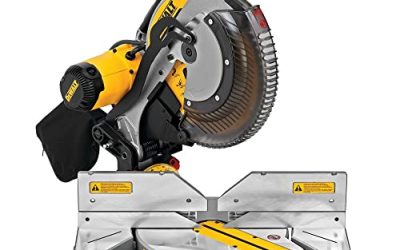
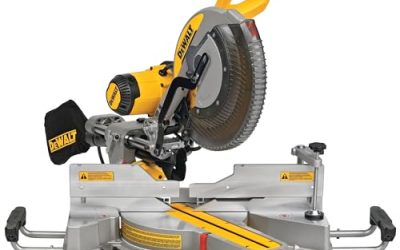
The DEWALT DWS779 is the workhorse pick for anyone who cuts a lot of wide dimensional lumber. Its sliding rails deliver a long crosscut that handles a 2-by-14 at 90 degrees and a 2-by-10 at 45 degrees, which covers most framing and decking cuts without repositioning the board. The tall sliding fences support crown molding stood vertically, and the oversized bevel scale with positive stops makes angle changes quick. A cam-lock miter handle locks the table firmly, and the dust chute helps keep the cut line visible.
Specs
- 15-amp motor with 3,800 RPM no-load speed
- 12-inch blade with increased crosscut capacity
- Crosscut capacity for 2-by-14 lumber at 90 degrees and 2-by-10 at 45 degrees
- Dual-bevel design with bevel stops and oversized bevel scale
- Includes blade wrench and material clamp
Best for: Framers and deck builders who need the widest crosscut in dimensional lumber.
Watch out for: The traditional rail design needs clearance behind the saw, so it takes more bench depth than compact-slide models.
Makita LS1219L
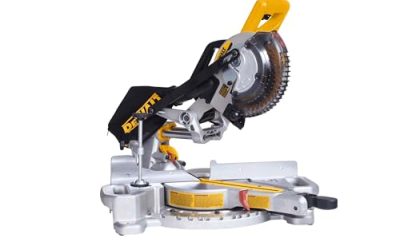
The Makita LS1219L stands out for shops where space is tight, because its dual-steel rail slide system lets the saw sit flush against a wall without the rails extending behind it. The built-in laser marks the cut line clearly, which helps when lining up trim cuts and repeated miters. Its bevel range reaches 48 degrees left and right, and the miter range reaches 60 degrees each way, giving it more angle coverage than most saws in this class. The direct-drive motor keeps the head compact, and the large base supports long boards steadily.
Specs
- 15-amp motor with 3,200 RPM no-load speed
- 12-inch blade with dual-steel rail sliding system
- Bevel capacity of 48 degrees left and right
- Miter range of 60 degrees left and right
- Built-in laser for cut-line alignment
- Designed for operation flush against a wall
Best for: Small workshops and trim carpenters who need a saw that works against a wall.
Watch out for: The compact rail system feels different from traditional tube rails, so take time to get used to the glide before cutting finish work.
Bosch GCM12SD

The Bosch GCM12SD uses an Axial-Glide system instead of traditional rails, with articulated arms that fold as the head slides. The result is a saw with a much smaller footprint that still delivers full 12-inch sliding capacity, making it a strong choice for a crowded bench or a mobile setup. The glide motion is smooth and controlled, with no rail play to throw off square cuts. It includes a 60-tooth blade suited to fine crosscuts, and the bevel scale is large and easy to read from the front of the saw.
Specs
- 15-amp motor with 3,800 RPM no-load speed
- 12-inch blade with 60-tooth blade included
- Axial-Glide system for a compact footprint
- Dual-bevel design with bevel capacity of 47 degrees left and right
- Large, easy-to-read bevel scale
Best for: Woodworkers who want a smooth glide and a saw that fits a shallow bench.
Watch out for: The articulated arm design has more moving joints than a simple rail system, so keep the pivot points clean and free of sawdust buildup.
Metabo HPT C12RSH2
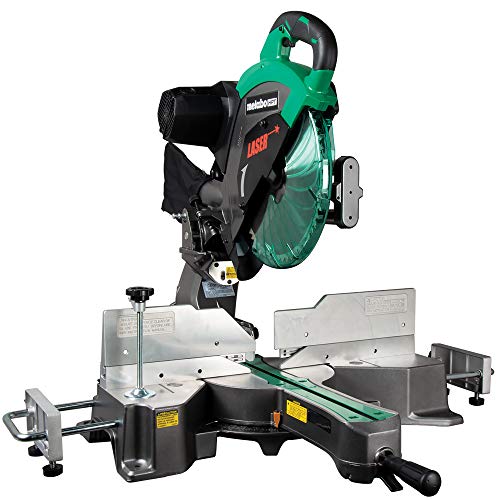
The Metabo HPT C12RSH2 pairs a compact slide system with a laser marker, giving trim carpenters a saw that needs no rear clearance and still lines up cuts precisely. Its large sliding fences support tall workpieces, and the 15-amp motor drives the 12-inch blade through hardwoods and dimensional lumber without bogging down. The five-year warranty is longer than most competitors offer, which matters if the saw will see daily use. It is a solid middle-ground choice that balances capacity, guidance features, and workshop footprint.
Specs
- 15-amp motor with 12-inch blade
- Dual-bevel sliding compound design with laser marker
- Compact slide system requiring no rear clearance
- Large sliding fences for tall workpieces
- Five-year warranty
Best for: Trim carpenters who want laser guidance and a compact saw with long warranty coverage.
Watch out for: The compact slide system trades some crosscut reach for its small footprint, so check the capacity against the widest boards you cut regularly.
Which One Fits Your Situation
Framing and Decking Work
Choose the DEWALT DWS779. Its long crosscut handles a 2-by-14 at 90 degrees, so wide deck boards and framing lumber go through in a single pass. The cam-lock miter handle and tall sliding fences keep long pieces stable, and the 3,800 RPM motor powers through dense lumber. If your days are mostly wide boards and rough cuts, this saw wastes the least time repositioning material.
A Small Shop or Garage
Choose the Makita LS1219L. The dual-steel rail system lets the saw sit flush against the wall, freeing up bench depth that a traditional rail saw would waste. The laser helps with accurate trim cuts in a tight space, and the 48-degree bevel range covers crown molding and other angled work. It is the best fit when every inch of bench space counts.
A Shared or Mobile Workbench
Choose the Bosch GCM12SD. The Axial-Glide arms fold instead of extending behind the saw, so it fits on a shallow bench and moves easily between job sites. The smooth glide keeps cuts square, and the included 60-tooth blade leaves clean edges on trim and sheet goods. It suits woodworkers who set up and break down their station often.
Daily Trim and Finish Carpentry
Choose the Metabo HPT C12RSH2. The laser marker speeds up cut alignment on repeated trim pieces, the large sliding fences support tall baseboard and crown, and the compact slide system keeps the saw close to the wall. The five-year warranty adds confidence for a saw that will run every working day.
Common Mistakes
- Buying a 12-inch saw for narrow trim work only and ignoring how much bench depth the rails need behind it.
- Skipping the bevel detents and freehanding crown molding angles instead of using the 33.9-degree stop.
- Cutting wide boards with a dull blade, which burns the edge and forces the motor to work harder than it should.
- Forgetting to check that the blade is square to the fence and the table before the first cut of the day.
- Placing the saw where the sliding rails hit the wall, which limits the crosscut and can damage the rails.
Frequently Asked Questions
What size blade does a 12-inch sliding compound miter saw use?
A 12-inch sliding compound miter saw uses a 12-inch diameter blade with a 1-inch arbor in most North American models. Blade choice matters as much as size: a 60-tooth carbide blade suits clean crosscuts in trim and hardwoods, while a lower tooth count suits faster rough cuts in framing lumber. Always match the blade to the material and the cut.
Can a 12-inch sliding miter saw cut a 2-by-14 board?
Yes, several models can crosscut a 2-by-14 at 90 degrees in a single pass, including the DEWALT DWS779. The sliding action extends the blade reach across the full width of the board. At a 45-degree miter, the same saw typically handles a 2-by-10. Always confirm the listed crosscut capacity for the model you buy.
Do I need a dual-bevel miter saw?
A dual-bevel saw tilts both left and right, so you can cut matching bevels on both ends of a board without flipping it. That saves time and keeps cuts consistent on crown molding and other trim. If you cut bevels often, dual bevel is worth having. For simple crosscuts and miters, a single-bevel saw can do the job.
How do I keep a sliding miter saw cutting square?
Check the blade against the fence with a square, then check the bevel setting at 0 degrees before starting work. Keep the slide rails clean and free of sawdust, and avoid forcing the head through the cut. A smooth, steady push lets the blade do the work and keeps the cut line true.