Our Short List of 3
- Type: Sealed AGM starting battery, 12 V
- Group size: 48 / H6
- Cold cranking amps: 760 CCA
- Capacity: 70 Ah

- Type: Sealed AGM starting battery, 12 V
- Group size: 48 / H6
- Cold cranking amps: 760 CCA
- Capacity: 70 Ah

- Type: Sealed AGM dual-purpose battery, 12 V
- Group size: 48 / H6
- Cold cranking amps: 800 CCA
- Capacity: 72 Ah
All 4 Picks at a Glance
| Product | Specs | Action |
|---|---|---|
| 1. Interstate MTX-48/H6 AGM Battery — Best Standard Fitment |
| Check price on Amazon |
| 2. Mighty Max MM-H6 AGM Battery — Best Value in the Standard Case |
| Check price on Amazon |
| 3. OPTIMA DH6 YellowTop Dual Purpose Battery — Best for Cars That Sit |
| Check price on Amazon |
 4. WEIZE Platinum AGM Group 94R Battery — Heavy-Duty Upgrade, Only If Your Car Takes the Larger Case |
| Check price on Amazon |
Key takeaways
- Find the best battery for a V8 Commodore with Group 48 H6 fitment for VE and VF cars, an H7 heavy-duty upgrade path, and the boot-mounted checks to make first.
As an Amazon Associate we earn from qualifying purchases.
Affiliate Disclosure: This article contains affiliate links. If you buy through a link on this page, we may earn a commission at no extra cost to you.
The V8 Commodore in this guide is the Holden Commodore — the Australian-built rear-wheel-drive sedan, wagon and ute sold in Australia and New Zealand, not a North American model. That market declaration matters, because the Commodore was never a regular United States showroom car in Holden form, its battery fitment follows European DIN sizing rather than the group sizes most American cars use, and the replacement batteries an Australian owner buys locally are often labelled with Australian codes that do not appear on United States listings at all. This guide translates between the two systems: it explains what a V8 Commodore actually takes, then gives picks you can order through Amazon US in the equivalent BCI group sizes, with the checks you must make before the battery goes into the boot.
We have not tested these batteries ourselves. Specifications below are taken from manufacturer and product listing information. Confirm the case size, terminal layout and vent arrangement against the battery already in your car before you order, because Commodore fitment changed across generations and a battery that is electrically strong enough can still be physically wrong.
Which Commodore Generations This Guide Covers
Commodore V8 production spans a long run of Holden platforms, and the battery story splits into two broad eras.
Earlier cars — VB through VS in the late 1970s to late 1990s, and VT through VZ from the late 1990s to the mid-2000s — carry the battery in the engine bay and use conventional Australian case codes. Australian fitment guides list those generations under their own local battery codes, and the safest route for those cars is to match the label on the battery you remove, including its terminal layout, rather than to convert blindly to a United States group size.
The modern era, and the focus of the picks below, is the VE (from 2006) and VF (to the end of local production in 2017). These cars moved the battery into the boot, on the left-hand side, and use DIN-style cases. Fitment data from Australian application guides lists the standard VE and VF battery in the DIN66 family, with a heavy-duty upgrade in the next case size up and an AGM upgrade listed for the same cars. In BCI terms used on Amazon US, the standard case corresponds to Group 48, also called H6 or LN3, and the larger heavy-duty case corresponds to Group 94R, also called H7 or DIN77. V8 versions — the 6.0-litre and 6.2-litre SS, SSV and HSV cars — sit at the demanding end of that fitment: a large-displacement V8 starter, a boot-mounted battery at the end of a long cable run, and, on many cars, years of short-trip and weekend-only use.
What a V8 Commodore Needs From a Battery
Four requirements decide whether a replacement is right, and only one of them is cranking power.
Case size and terminal layout come first. A VE or VF car needs the DIN66 / H6 footprint as standard, with the correct terminal polarity and a hold-down that engages the case properly. A battery that is too tall fouls the boot trim and the compartment cover; a battery that is too small shifts under the clamp. Measure the old battery or read its label — do not rely on a generic Commodore listing, because the heavy-duty and police-pack variants used the larger case.
Cranking amps need to suit a big V8. Australian guides put typical Commodore batteries in a broad band, with V8 variants at the higher end. Every pick below is rated at 760 cold cranking amps or more in its standard H6 form, which gives a healthy margin for a 6.0-litre or 6.2-litre engine, including the slower, heavier crank of a cold morning or a hot restart after heat soak in traffic.
The battery lives in a closed compartment, so venting matters. A boot-mounted battery must be a sealed design or must have its vent connected exactly as the original was, so that gases are routed out of the compartment rather than into the boot. This is a strong practical argument for the sealed AGM batteries in this guide: their electrolyte is held in glass mat separators, they are spill-proof, and they suit an enclosed mounting position far better than an open flooded battery of the same size.
Reserve capacity matters because these cars sit. Many V8 Commodores are now second cars, weekend cars or held classics. A parked VE or VF still draws current for its alarm, keyless entry and body electronics, and a battery that is repeatedly pulled down and left there will sulphate and lose capacity. Reserve capacity — how long the battery can supply a modest load — is the published figure that best reflects that parked endurance, and it is why the picks below are compared on reserve as well as cranking.
Why We Recommend AGM for This Car
VE and VF Commodores left the factory with conventional maintenance-free batteries on most variants, and a correct flooded replacement will start the car. We still steer V8 owners to AGM for three concrete reasons. First, the sealed construction suits the boot compartment, as explained above. Second, AGM batteries tolerate the partial-discharge pattern of a car that is driven briefly and then parked for weeks better than a basic flooded battery does. Third, AGM construction is more resistant to vibration, which matters in a stiffly sprung SS or HSV.
AGM is not a cure for storage neglect. Any lead-acid battery left discharged will be damaged, whatever its construction, and the maintainer advice later in this guide matters more than the badge on the case.
A Note on the Factory-Style ACDelco Option
Australian owners will know the ACDelco name well, and the ACDelco Gold 48AGM is the factory-style Group 48 AGM battery that United States listings most often recommend for H6 applications, with 760 cold cranking amps and a 120-minute reserve capacity on paper. We have deliberately not listed it as a pick here. Checks of its Amazon US listing in earlier work for this site network repeatedly recorded no featured offer available on that listing, and our rule is to recommend only products we can point to as genuinely buyable. Use its specification — Group 48 / H6, AGM, cranking and reserve in that class — as a template if you shop locally in Australia instead, and verify any listing you do buy from shows a live offer first.
The Picks
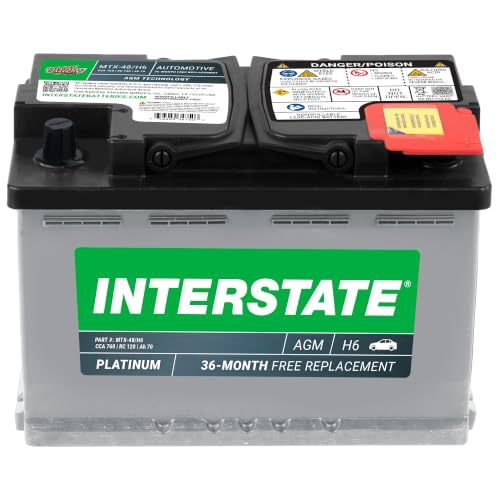
1. Interstate MTX-48/H6 AGM Battery — Best Standard Fitment
- Type: Sealed AGM starting battery, 12 V
- Group size: 48 / H6
- Cold cranking amps: 760 CCA
- Capacity: 70 Ah
The MTX-48/H6 is the most straightforward answer for a standard VE or VF V8: the correct H6 case, 760 cold cranking amps for the big starter, 70 amp-hours of capacity and a 120-minute reserve for a car that does not get driven every day. Interstate publishes those figures for this exact part number in its own MTX line data, including the case dimensions and a 36-month free replacement warranty for the line, which makes this the best-documented standard-fitment pick in the guide.
Interstate is also a battery specialist rather than a general marketplace brand, and the MTX line is its AGM range for cars and trucks. For a Commodore owner ordering from the United States, that combination — a named part number, published dimensions, and figures that agree between the maker and the listing — is worth more than a headline cranking number on an unbranded case. Measure your tray against the published dimensions before ordering, and confirm the terminal positions match the battery you remove.
2. Mighty Max MM-H6 AGM Battery — Best Value in the Standard Case
- Type: Sealed AGM starting battery, 12 V
- Group size: 48 / H6
- Cold cranking amps: 760 CCA
- Capacity: 70 Ah
On published figures, the MM-H6 matches the Interstate pick figure for figure: Group 48 / H6 case, 760 cold cranking amps, 70 amp-hours and 120 minutes of reserve capacity, in a sealed AGM design the maker describes for start-and-stop duty. That makes it the value alternative in the standard Commodore case size — the same electrical specification, from a budget battery brand rather than a national battery network.
The trade-off is support rather than specification. A smaller brand’s warranty handling depends on the seller rather than on a dealer network you can walk into, which matters more on a heavy shipped item like a car battery. Read the listing’s warranty terms before you buy, keep the paperwork, and — as with every pick here — verify the dimensions and terminal layout against your car, because a Group 48 label alone does not guarantee the hold-down and cable reach will suit the Commodore’s boot compartment.
3. OPTIMA DH6 YellowTop Dual Purpose Battery — Best for Cars That Sit
- Type: Sealed AGM dual-purpose battery, 12 V
- Group size: 48 / H6
- Cold cranking amps: 800 CCA
- Capacity: 72 Ah
The DH6 YellowTop puts the strongest figures in this guide into the standard H6 case: 800 cold cranking amps, 72 amp-hours and a 140-minute reserve capacity. It is also the only dual-purpose pick here — OPTIMA builds the YellowTop line both to start the engine and to tolerate deeper discharge cycling than a pure starting battery likes. For the way many V8 Commodores are actually used now — driven at weekends, parked for weeks, sometimes carrying an uprated stereo or other accessories fitted over a long life — that cycling tolerance is the relevant advantage, and the extra reserve capacity is real parked endurance.
Two cautions. The DH6 is a heavy battery for its case size, at around 54 pounds in published data, and the Commodore’s battery sits in a boot compartment you have to lift it into and out of at an awkward angle — plan the lift. And dual-purpose construction tolerates discharge better; it does not make discharge harmless. A YellowTop left flat for a month will still lose life. Pair it with the maintainer habit below and it is the strongest pick in this guide; skip the maintainer and no battery on this page will save you.
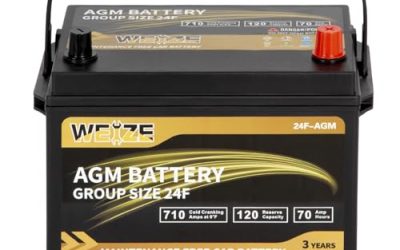
4. WEIZE Platinum AGM Group 94R Battery — Heavy-Duty Upgrade, Only If Your Car Takes the Larger Case
- Type: Sealed AGM starting battery, 12 V
- Group size: 94R / H7
- Cold cranking amps: 850 CCA
- Capacity: 80 Ah
Australian fitment guides list a heavy-duty upgrade for VE and VF Commodores in the case size above the standard battery, and this Group 94R / H7 battery is that step up in United States sizing: 850 cold cranking amps, 80 amp-hours and 140 minutes of reserve. For an HSV, a modified V8, or a car with serious audio and accessory loads, that extra capacity and cranking margin is a genuine upgrade — provided the car can physically take it.
That proviso is the whole point of this pick, so read it carefully. The H7 case is longer than the standard H6 case — the listing gives dimensions of 12.4 by 6.89 by 7.48 inches — and not every VE or VF battery compartment, hold-down and cable run accepts it. Only choose this battery if the battery already in your car is the larger heavy-duty size, or you have measured the compartment and confirmed the larger case, the hold-down and the vent arrangement all work. If your car takes the standard case, choose one of the H6 picks above instead; forcing an oversize battery into a boot compartment helps nobody.
Buying From the United States for an Australian Car
Because this guide is published for readers who may be ordering through Amazon US, three practical points deserve stating plainly. First, a car battery is heavy, and international freight on a single battery can change the economics completely — many Australian owners will be better served buying the same specification locally, using the group sizes and figures above as the shopping template. Second, core charges, return arrangements and warranty handling differ by seller, and returning a faulty battery internationally is rarely simple; factor that into the choice between a national brand and a marketplace brand. Third, Australian-delivered batteries for these cars are sold under local codes — the DIN66 family for standard cars and the larger DIN77 family for the heavy-duty fitment — so if you shop locally, ask for those codes and the CCA and reserve figures from this guide rather than a United States group number.
Keeping a Commodore Battery Alive
More V8 Commodore batteries now die from sitting than from starting, and these habits decide how long any pick above lasts.
- Use a battery maintainer whenever the car will sit for more than about two weeks. The boot compartment has access points for charging on these cars; follow the owner’s manual for your series, and use a maintainer with an AGM mode for the batteries in this guide.
- Drive the car properly when you do drive it. A short run to the shops barely replaces what the start took out of a big V8. A run long enough to bring everything fully up to temperature is what recharges the battery.
- Check for parasitic draw if the car keeps going flat. A healthy Commodore should hold charge for weeks. If yours dies in days, an aftermarket alarm, audio installation or a faulty module is the likely cause, and a new battery will not fix it.
- Keep the boot compartment connections clean and the vent connected. Corrosion and a disconnected vent are both easy to miss in a compartment you rarely open.
- Test before winter. A battery weakened by a summer of sitting is the one that fails on the first cold start.
Installation Notes
On VE and VF cars the battery is in the boot, behind a trim panel on the left-hand side. Work with the ignition off, remove the negative terminal first, release the hold-down, and lift the old battery out carefully — it is heavy and the angle is awkward. Fit the new battery, secure the hold-down before reconnecting, connect positive first and negative last, and reconnect the vent arrangement exactly as the original was fitted. Expect the car to need clock, window and other relearn items afterwards, and check for any battery-related settings in the owner’s manual for your series. On earlier engine-bay cars the job is more conventional, but the same terminal order applies. If you are not comfortable lifting a battery of this weight out of a boot compartment, a battery service will fit one quickly — the expensive mistake is a short circuit or a strained back, not the labour charge.
Frequently Asked Questions
What battery does a V8 Commodore take?
For the modern VE and VF cars covered by the picks above, the standard fitment is the DIN66 family, which corresponds to Group 48 / H6 on United States listings, with a larger heavy-duty case — DIN77, or Group 94R / H7 — listed as an upgrade for some variants. Earlier generations use Australian engine-bay fitments; match the label on the battery you remove.
Can I fit the larger H7 battery to any V8 Commodore?
No. Only cars whose compartment, hold-down and cables accept the longer case. If your car has the standard case, an H6 pick is the correct choice regardless of the H7 battery’s higher figures.
Does a V8 Commodore need an AGM battery?
Not strictly — most left the factory with conventional maintenance-free batteries. We recommend AGM because the battery lives in a closed boot compartment, because AGM tolerates the parked-and-driven pattern of a weekend car better, and because it resists vibration well. A correct flooded battery, kept charged, will still start the car.
Why does my Commodore keep going flat?
Usually a combination of normal parked current draw and long storage, sometimes worsened by an aftermarket accessory or a battery that has already lost capacity. Charge and test the battery first; if it tests well, have the parasitic draw measured before replacing parts.
Verdict
For a standard VE or VF V8, start with the Interstate MTX-48/H6 (ASIN: B09G4J6ZV4): correct H6 case, 760 CCA, and maker-published figures throughout. The Mighty Max MM-H6 (ASIN: B0CZFW3N6M) matches those figures as the value alternative. For a car that sits more than it drives, the OPTIMA DH6 YellowTop (ASIN: B07QSBXDWB) adds cranking power, reserve and cycling tolerance in the same case. The WEIZE Group 94R (ASIN: B0CBQ4GR6T) is the heavy-duty step up only for cars confirmed to take the larger H7 case. Whichever you choose, confirm the case and vent against the battery in the boot before you order — on this car, fitment is the decision, and cranking amps are only the tie-breaker.