Our Short List of 3
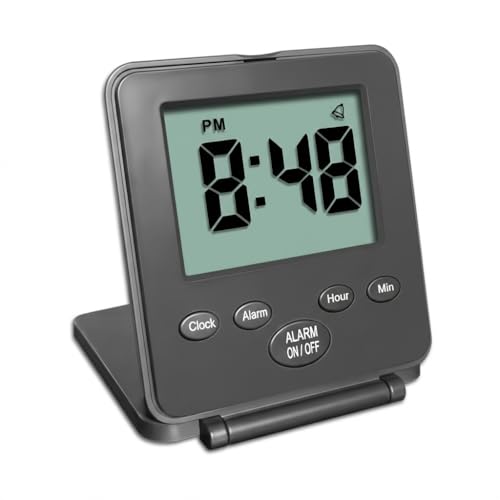
- Best for: Travelers and anyone who wants the simplest small alarm clock.

- Best for: Bedside use in a dark bedroom where a soft-touch, no-glow clock matters.

- Best for: Nightstands where large numbers and a phone charging port are priorities.
All 4 Picks at a Glance
| Product | Specs | Action |
|---|---|---|
| Travelwey Digital Travel Alarm Clock |
| Check price on Amazon |
| SHARP Battery Alarm Clock SPC483 |
| Check price on Amazon |
| DreamSky Small Digital Alarm Clock DS312 |
| Check price on Amazon |
 Peakeep Small Digital Alarm Clock |
| Check price on Amazon |
Key takeaways
- Find the best mini alarm clocks for small nightstands, dorms, and travel, with clear displays, gentle ascending alarms, simple controls, and compact designs.
A full-size alarm clock can take over a small nightstand, crowd a dorm desk, or add bulk to a travel bag. The best mini alarm clocks solve that problem without giving up the basics: a readable display, an alarm loud enough to wake you, a snooze button you can find without thinking, and controls that make sense when you are half asleep.
Mini alarm clocks are not all the same. Some are battery powered and fold flat for travel. Others plug in and add a USB charging port. Some focus on large numbers, a dimmer, or an ascending alarm that starts quietly and grows louder. The right choice depends on where the clock will live, how much light you want at night, and whether you need it to work away from an outlet. Based on specifications, features, and user feedback, this guide compares size, power, display, alarm style, and ease of use.
Disclosure: As an Amazon Associate, we earn from qualifying purchases.
Quick Picks at a Glance
| Product | Key Spec | Best For |
|---|---|---|
| Travelwey Digital Travel Alarm Clock | 2.76 x 1.50 x 3.15 inches, 2 AAA batteries | Simplest travel clock |
| SHARP Battery Alarm Clock SPC483 | 4 x 1.7 x 2.3 inches, 2 AAA batteries, blue backlight | Soft-touch bedside clock |
| DreamSky Small Digital Alarm Clock DS312 | 5.3 x 1.4 x 2.6 inches, USB charging port | Large numbers and phone charging |
| Peakeep Small Digital Alarm Clock | 5.5 x 2.5 inches, 6 dimmer levels, 5 alarm volumes | Adjustable brightness and volume |
How to Choose
1. Size and footprint
Mini means different things to different makers, so check the actual dimensions before you buy. A clock about 3 inches on each side fits almost anywhere, while a clock 5 to 6 inches wide still counts as compact but needs a little more room. Measure your nightstand first, and leave room for a lamp or a book. For travel, choose a flat or folding design that stands on its own.
2. Power source
Battery-powered mini alarm clocks are the most flexible choice for travel, dorm rooms, and power cuts. Most use AAA or AA batteries, which are easy to replace. Plug-in clocks usually have a brighter display and extras such as a USB port, but they need an outlet and may lose the display in a power cut without battery backup. Decide whether portability or a brighter display matters more.
3. Display readability
You should be able to read the time from your pillow without glasses and without turning on a lamp. Large digits help older adults, children, and anyone with limited eyesight. An on-demand backlight is useful at night, while a display that stays lit can disturb light sleepers. Look for a dimmer, or a display that can be turned off completely.
4. Alarm sound and volume
An alarm that starts too loudly can leave you startled, while one that is too quiet can leave you asleep. An ascending alarm, which begins faintly and grows louder, is a good middle ground. Adjustable volume is even better, because it lets light sleepers choose a gentle wake-up and heavy sleepers choose a stronger sound. If you share a room, choose a lower volume setting. Check whether the alarm repeats and whether it has a clear on and off switch.
5. Snooze and night light
Snooze is one of the most used features on any alarm clock, so it should be easy to find by touch. A large top button is ideal, especially in the dark. A snooze of about five to nine minutes is standard and gives you a short extra rest without letting you fall back into deep sleep. Some clocks light the display for a few seconds when you press a button. A short, on-demand light is better for dark bedrooms.
6. Ease of setting
A mini alarm clock should be simple to set, even when you are tired. Top-mounted buttons are easier to reach than small buttons hidden on the back, and clear labels reduce mistakes. Extra features should not make the basic alarm harder to use, especially for children, older adults, and guests.
7. Build, grip, and placement
Small clocks are easy to knock over, so a stable base and a grippy case help. A soft-touch finish can stop sliding, and a folding cover can protect the display in a bag and double as a stand.
Top Picks
Travelwey Digital Travel Alarm Clock
- Best for: Travelers and anyone who wants the simplest small alarm clock.
Travelers and anyone who wants the simplest small alarm clock.
Travelwey Digital Travel Alarm Clock
The Travelwey Digital Travel Alarm Clock is built around one idea: keep it simple. It measures 2.76 x 1.50 x 3.15 inches, runs on 2 AAA batteries, and folds into a shape that fits a pocket or a small travel pouch. The flip cover protects the display when closed and acts as a stand when open, so you can set it on a hotel nightstand or a desk without extra support.
The alarm is loud enough for most sleepers, with snooze for a few extra minutes. A five-second night light lets you check the time without a lamp, and an on and off switch shows whether the alarm is armed. Battery power means it works anywhere, with no cord and no outlet, which suits travel, camping, dorm rooms, and guest rooms.
Pros:
– Very compact folding design at 2.76 x 1.50 x 3.15 inches
– Battery powered with 2 AAA batteries for use anywhere
– Flip cover protects the display and works as a stand
– Loud alarm with snooze and a five-second night light
Cons:
– Basic display with no temperature or calendar readout
– Small buttons may feel fiddly for larger hands
– Batteries are required and are not always included
SHARP Battery Alarm Clock SPC483
- Best for: Bedside use in a dark bedroom where a soft-touch, no-glow clock matters.
Bedside use in a dark bedroom where a soft-touch, no-glow clock matters.
SHARP Battery Alarm Clock SPC483
The SHARP Battery Alarm Clock SPC483 is a small bedside clock with a soft-touch case that is easy to grip and hard to knock over. It measures 4 x 1.7 x 2.3 inches and runs on 2 AAA batteries, so it works on a nightstand, a desk, or a shelf without a cord. The rubberized finish sets it apart from smooth plastic clocks, and the compact shape fits neatly beside a lamp or a phone.
The display is clear, with a blue backlight on demand, so you can check the time and return to darkness, which suits light sleepers and shared bedrooms. The alarm ascends from quiet to loud, top controls keep setting simple, and snooze is easy to reach. It suits bedrooms, kids rooms, and dorm rooms where a simple, sturdy clock beats extra features.
Pros:
– Soft-touch rubberized case that resists slipping
– Compact size at 4 x 1.7 x 2.3 inches
– Blue backlight on demand for nighttime checks
– Ascending alarm with easy top controls and snooze
Cons:
– Display is smaller than jumbo-screen models
– Runs on 2 AAA batteries, which need replacing over time
– No USB charging port or extra display features
DreamSky Small Digital Alarm Clock DS312
- Best for: Nightstands where large numbers and a phone charging port are priorities.
Nightstands where large numbers and a phone charging port are priorities.
DreamSky Small Digital Alarm Clock DS312
The DreamSky Small Digital Alarm Clock DS312 is a low, wide mini clock designed for easy reading from across a room. It measures 5.3 inches long, 1.4 inches wide, and 2.6 inches high, with large big numbers that stand out. That wide format sits low and stable on a nightstand or desk, and it is still compact enough for a small bedroom or dorm room.
A brightness dimmer lets you keep the display bright by day and softer at night. Adjustable alarm volume lets you choose a gentle sound or a stronger wake-up call. Powered by a USB-C adapter, it also includes a USB charging port, so you can charge a phone from the same spot and reduce clutter.
Pros:
– Large big numbers display in a low, stable format
– Brightness dimmer for day and night comfort
– USB charging port plus USB-C adapter power
– Adjustable alarm volume for light and heavy sleepers
Cons:
– Needs an outlet, so it is less portable than battery-only clocks
– Wider footprint than folding travel clocks
– No battery-only mode for use away from power
Peakeep Small Digital Alarm Clock
- Best for: Light-sensitive sleepers who want precise control over brightness and volume.
Light-sensitive sleepers who want precise control over brightness and volume.
Peakeep Small Digital Alarm Clock
The Peakeep Small Digital Alarm Clock is a compact plug-in clock with a strong focus on control. It measures 5.5 x 2.5 inches, with a large LED display that is easy to read from bed. Six dimmer levels, including an off option, let you fine-tune brightness for a dark room or a bright desk, which suits anyone sensitive to light at night.
Alarm volume is adjustable across five levels, from 55 to 90 decibels, so you can pick a soft wake-up or a louder call. A nine-minute snooze gives you a standard extra rest. An adapter provides continuous power, and four AAA batteries back up settings during a power cut, so you do not have to reset the time and alarm after an outage.
Pros:
– Six dimmer levels, including an off setting
– Five alarm volume levels from 55 to 90 decibels
– Nine-minute snooze for a standard extra rest
– Battery backup with four AAA batteries preserves settings
Cons:
– Needs an adapter for continuous operation
– Larger than folding travel clocks
– Display brightness range may take a night or two to dial in
Comparison Table
| Feature | Travelwey | SHARP SPC483 | DreamSky DS312 | Peakeep Digital |
|---|---|---|---|---|
| Size | 2.76 x 1.50 x 3.15 inches | 4 x 1.7 x 2.3 inches | 5.3 x 1.4 x 2.6 inches | 5.5 x 2.5 inches |
| Power | 2 AAA batteries | 2 AAA batteries | USB-C adapter | Adapter plus 4 AAA backup |
| Display | LCD, basic | LCD, blue backlight on demand | Large LED numbers, dimmer | Large LED numbers, 6 dimmer levels |
| Alarm | Loud alarm, snooze | Ascending alarm, snooze | Adjustable volume | 5 volumes, 55 to 90 decibels, 9-minute snooze |
| Standout feature | Folding cover and stand | Soft-touch case | USB charging port | Brightness and volume control |
Buying Guide
Start with where the clock will live. A travel clock needs to be small, light, and battery powered, with a cover that protects the display. A bedside clock can be wider and may benefit from a plug-in design, a dimmer, and a USB port. A clock for a childs room needs simple controls and a gentle alarm.
Next, think about your sleep. Light sleepers often prefer an ascending alarm, a low volume setting, and a display that can be dimmed or turned off. Heavy sleepers need a louder alarm and a clear snooze. If you share a room, choose adjustable volume and a short night light.
Power is the third decision. Battery clocks are best for travel and rooms with few outlets, but keep spare batteries on hand. Plug-in clocks suit a fixed nightstand, especially if you also want to charge a phone, but check for battery backup, since a clock that loses its time in a power cut can leave you late.
Avoid common mistakes. Check the dimensions and display size in the listing, and do not assume a clock has a dimmer or snooze just because it looks modern. Do not place it behind a lamp or book stack, where you cannot reach snooze. Set a backup alarm on the first night until you are confident it wakes you reliably.
Frequently Asked Questions
What size counts as a mini alarm clock?
A mini alarm clock is usually under about 6 inches wide and under about 3 inches high. The picks here range from about 2.76 inches to 5.5 inches wide, so check the listed dimensions for each model.
Are battery-powered mini alarm clocks reliable?
Yes, when they use fresh batteries and a simple design. Battery clocks work during power cuts and away from outlets. Keep spare AAA or AA batteries on hand, and replace them when the display dims or the alarm sounds weak.
Do mini alarm clocks have a snooze button?
Most do, and the snooze is usually five to nine minutes. The Travelwey and SHARP models include snooze, and the Peakeep model uses a nine-minute snooze. Look for a large top button for easy snoozing in the dark.
Can a mini alarm clock wake a heavy sleeper?
It can, if you choose adjustable volume and a loud setting. The Peakeep model offers five volume levels up to 90 decibels, and the DreamSky model offers adjustable volume. Place the clock close to your bed and use a backup alarm until you know it works for you.
Is a plug-in mini alarm clock better than a battery one?
It depends on where you will use it. A plug-in clock usually has a brighter display, a dimmer, and sometimes a USB port, which suits a fixed nightstand. A battery clock is better for travel, for a room without a nearby outlet, and for use during a power cut.
How do I keep a mini alarm clock from glowing all night?
Choose a model with a dimmer or an off setting, and use the backlight only on demand. The Peakeep model has six dimmer levels including off, the DreamSky model has a brightness dimmer, and the SHARP model uses a blue backlight only when you press for it.
Conclusion
The best mini alarm clocks prove that a small clock can still be clear, reliable, and easy to use. If you travel often or want the simplest option, the Travelwey Digital Travel Alarm Clock is the easiest to pack and the easiest to set. If you want a sturdy bedside clock with a soft-touch case and a gentle ascending alarm, the SHARP SPC483 is a strong match. If large numbers and a phone charging port matter most, the DreamSky DS312 fits a nightstand well. If you want the most control over brightness and volume, the Peakeep Small Digital Alarm Clock gives you six dimmer levels and five alarm volumes in a compact plug-in design.
Start by measuring your space, then choose the power source and display that suit your sleep. Pick the model that matches your routine, set it up on the first night, and let a small, simple clock take over the job your phone used to do.