Key takeaways
- Compare the best batteries for a Toyota Sienna in the correct Group 24F size, with CCA, reserve capacity, terminal layout and fitment checks before you buy.
As an Amazon Associate we earn from qualifying purchases.
Affiliate Disclosure: This article contains affiliate links. If you buy through a link on this page, we may earn a commission at no extra cost to you.

A Toyota Sienna asks more of its battery than a small sedan does. It is a heavy minivan with power sliding doors, a power liftgate on many trims, heated seats, rear entertainment on some models, and a starter that has to turn over a V6 engine, or support the electrical system on hybrid versions where the twelve-volt battery still runs the accessories and the control electronics. When that battery weakens, the Sienna rarely fails politely. You get slow cranking on a cold morning, flickering accessories, warning lights that come and go, and doors or a liftgate that behave strangely because the voltage sags under load. Choosing a replacement is therefore not about finding the most powerful battery you can buy. It is about finding the right battery: the correct group size, the correct terminal layout, enough cold cranking amps for your climate, and enough reserve capacity for the way a family minivan is actually used.
This guide focuses on that fitment question first, then compares two Group 24F AGM batteries that match the size most Sienna models use. We did not test these batteries ourselves. The specifications below come from manufacturer and published listing information for each model, and every code in this article is recorded as a candidate, not as verified, because the live Amazon US product pages could not be read in full at the time of writing. Check the listing again before you order, and confirm fitment for your exact model year, because Sienna battery requirements have changed across generations and the hybrid models in particular should always be matched against the owner manual.
Quick picks
- Best overall for most Sienna owners: WEIZE Platinum AGM Battery, BCI Group 24F — a sealed AGM battery rated at 710 cold cranking amps, 70 amp-hours and 120 minutes of reserve capacity, in the exact Group 24F case the Sienna tray is built around.
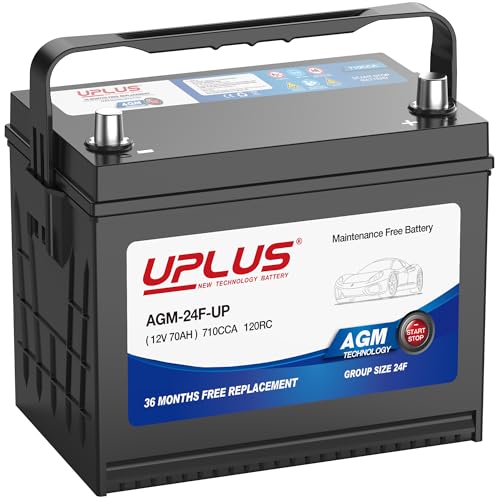
- Best alternative with the same headline ratings: UPLUS BCI Group 24F AGM Car Battery — another 24F AGM option rated at 710 cold cranking amps, 70 amp-hours and 120 minutes of reserve capacity, designed for vehicles with large electrical loads and frequent short trips.
What size battery does a Toyota Sienna use?
Most Toyota Sienna models use a BCI Group 24F battery. That group size defines the case dimensions and the terminal layout, and both matter. A Group 24F case measures roughly 10.75 inches long, 6.81 inches wide and 8.98 inches tall, and its terminals are arranged with the negative terminal on the left and the positive terminal on the right when you look at the battery from the front. The F in 24F is not decoration. A standard Group 24 battery has the terminal polarity reversed compared with a 24F, so a battery that looks almost identical can leave your cables stretched toward the wrong posts, or simply unable to reach safely. Never buy a Group 24 battery for a Sienna that calls for a 24F and assume the cables will cope.
Generations differ in detail, so treat the group size as the starting point rather than the whole answer. Earlier Sienna models with the V6 engines are straightforward 24F applications in most cases. Later models add start-stop behaviour, heavier accessory loads, and in the hybrid generation a very different drivetrain in which the twelve-volt battery no longer cranks the engine in the traditional way but still powers the electronics that wake the vehicle up. A weak twelve-volt battery on a hybrid Sienna can leave the van unable to enter its ready mode even though the high-voltage system is healthy. Whatever generation you own, confirm the group size, the minimum cold cranking amps and any venting or sensor requirements in the owner manual or on the label of the battery you are removing, and match the replacement to those figures.
The numbers that actually matter
Cold cranking amps
Cold cranking amps, or CCA, describe how much current a battery can deliver for starting at zero degrees Fahrenheit. Cold is the hard case because engine oil thickens, the starter works harder, and the chemical reaction inside the battery slows down at the same time. Both picks in this guide are rated at 710 CCA, which is a strong figure for a Group 24F battery and comfortably suited to V6 Sienna models in cold climates. If you live somewhere mild, you may never need the full rating, but CCA headroom is also a useful buffer as a battery ages, because an older battery that has lost some capacity still starts reliably if it began with margin to spare.
Reserve capacity
Reserve capacity, or RC, is measured in minutes and describes how long a fully charged battery can carry a moderate electrical load before its voltage falls too low. For a Sienna this matters in everyday family use: children watching a screen with the engine off, doors opening and closing repeatedly at a campsite or a sports practice, a liftgate cycling while you unload shopping, or lights left on in a car park. Both batteries here are rated at 120 minutes of reserve capacity, which is a solid figure for the size and a meaningful reason to choose them over cheaper batteries in the same case that quietly offer far less.
Capacity in amp-hours
Amp-hour capacity describes the total energy the battery can store. Both picks are rated at 70 amp-hours. For a starting battery this is a supporting figure rather than the headline, but it tracks closely with reserve capacity and with how gracefully the battery handles repeated short trips, where the alternator never quite gets the chance to replace what each start took out.
AGM construction
Both picks use absorbed glass mat construction. In an AGM battery the electrolyte is held in glass fibre separators rather than sloshing freely, which makes the battery sealed, spill-resistant and more tolerant of vibration than a conventional flooded battery. AGM batteries also suit vehicles with large electrical loads and stop-start style use, and they generally tolerate deeper discharge and recharge cycles better than a basic flooded unit. The trade-offs are weight and the need for correct charging: an AGM battery should be charged with a charger that has an AGM mode, and the charging guidance published for the WEIZE, for example, gives a charging voltage range of 14.4 to 15.0 volts and an acceptable charging current of up to 21 amps. Match your charger to that guidance rather than forcing a fast charge the battery was not designed for.
The picks in detail
1. WEIZE Platinum AGM Battery, BCI Group 24F
ASIN: B0D6Y7KQYN — candidate. This code was identified from the indexed Amazon US listing naming the WEIZE Platinum AGM Battery in BCI Group 24F, which confirms the product name, group size, ratings, dimensions and manufacturer part number QTF-24F. The live product page could not be read in full at the time of writing, so the code is recorded as a candidate, not verified, and its featured offer and stock status still need a live check before purchase.
The WEIZE Platinum is the natural first pick for a Sienna because it is built in exactly the case the van expects. Its published dimensions are 10.75 inches long by 6.81 inches wide by 8.98 inches high, its tapered terminals sit with negative on the left and positive on the right, and it weighs about 46.1 pounds, which is normal for a lead AGM battery of this size and a reminder to lift it with care or ask for help during installation. The ratings are 12 volts, 70 amp-hours, 710 cold cranking amps and 120 minutes of reserve capacity, and the listing describes it as a start-stop capable automotive battery with a 36-month warranty period stated by the maker.
In practical terms, that specification suits the Sienna well. The cranking figure covers confident V6 starts in winter, the reserve figure covers the door, liftgate and accessory loads that define minivan life, and the sealed AGM design means no topping up and no acid spills in an engine bay that sits close to the cabin of a family vehicle. The manufacturer advises checking dimensions and terminal position before purchase and using the fitment confirmation tool on the listing, and that advice is worth following literally: measure your old battery, photograph the cable routing, and confirm the hold-down arrangement before the new battery arrives.
Choose the WEIZE if your Sienna takes a Group 24F battery, if you want AGM construction rather than a basic flooded replacement, and if your driving includes the short trips, school runs and stop-and-go use that punish a weak battery. Skip it, or at least pause, if your model year calls for a different group size, if your van is a hybrid version whose manual specifies a particular battery type or vent arrangement, or if the listing’s live fitment check disagrees with your vehicle details.
2. UPLUS BCI Group 24F AGM Car Battery
ASIN: B0GBTDJ8N7 — candidate. This code was identified from published listing information naming the UPLUS BCI Group 24F AGM Car Battery, including a listing link to the Amazon US product page for that exact model. The live product page could not be read in full at the time of writing, so the code is recorded as a candidate, not verified, and its featured offer and stock status still need a live check before purchase.
The UPLUS matches the WEIZE on the headline numbers and differs mainly in the details of its construction claims and its maker. It is a BCI Group 24F battery rated at 12 volts, 70 amp-hours, 710 cold cranking amps and 120 minutes of reserve capacity, with published dimensions of 10.7 inches long by 6.77 inches wide by 8.98 inches high and the same left-negative, right-positive terminal layout a Sienna needs. It weighs about 46.8 pounds. The maker, UPLUS New Technology Battery, describes the model, part number AGM-24F-UP, as a maintenance-free start-stop battery designed for vehicles with large electrical loads such as navigation systems, heated seats and power doors, and for vehicles used for frequent short trips, stop-and-go traffic, or left unused for days or weeks at a time. The maker also states a three-year warranty period and claims extended cycle life compared with standard conventional batteries.
That description reads almost like a Sienna use case, which is why this battery earns its place as the alternative pick. Power doors, heated seats and short family trips are exactly the loads and patterns that flatten an ageing battery, and a battery designed and marketed for that duty is a sensible match. As with the WEIZE, the honest limitation is fitment discipline: a Group 24F battery is correct for Sienna models that specify 24F, and it is the wrong battery for any vehicle, including any unusual Sienna variant, whose tray, terminals or manual call for something else.
Choose the UPLUS if you want a second 24F AGM option with the same cranking and reserve ratings, if the WEIZE listing is unavailable when you come to buy, or if its stated warranty and start-stop positioning suit your use better. Between the two, there is no dramatic performance gap on the published figures, so availability, warranty handling and the live fitment confirmation on the day you order are reasonable deciding factors.
How to confirm fitment before you order
Start with the battery already in the van. Its label usually states the group size, the cranking rating and the date of manufacture, and a photograph of that label answers most questions. Measure the tray if anything looks non-standard, and note which side each cable comes from, because terminal position is the difference between a ten-minute swap and a battery you have to return. Then check the owner manual for your model year, especially on hybrid models, where the twelve-volt battery specification and its location and venting can differ from the petrol-only generations.
Next, use the fitment confirmation tool on the product listing itself and enter your exact year, trim and engine. Treat a confirmed fit as a strong signal but not a guarantee, and treat any conflict between the tool and your manual as a reason to stop and resolve the discrepancy first. Finally, think about installation. A Group 24F AGM battery weighs in the mid-forty-pound range, lives in a snug engine bay, and on some vehicles the vehicle may need its battery registered or its systems reset after a swap. If you are not comfortable lifting the battery, handling terminals safely, or dealing with memory settings and warning lights afterwards, having the battery fitted by a shop is a reasonable choice rather than a defeat.
Habits that make a Sienna battery last
Most Sienna batteries die early for boring reasons. Repeated short trips never fully recharge the battery, so an occasional longer drive, or a maintenance charge with an AGM-compatible charger during quiet periods, helps considerably. Power doors and liftgates are heavy loads, so avoid cycling them repeatedly with the engine off. Keep terminals clean and tight, because a corroded or loose connection can imitate a failing battery and can also prevent proper charging. If the van will sit unused for weeks, a maintainer is kinder than a jump pack after the fact. And when starting becomes noticeably slower, treat it as information: a battery that cranks slowly on a mild day is telling you it will not crank at all on the coldest day of the year, usually at the least convenient moment.
Frequently asked questions
What group size battery does a Toyota Sienna take?
Most Sienna models take a BCI Group 24F battery, with dimensions of roughly 10.75 by 6.81 by 8.98 inches and the positive terminal on the right. Confirm your model year in the owner manual or on the label of the existing battery, because specifications can vary by generation.
Is a Group 24 battery the same as a Group 24F?
No. The cases are close in size but the terminal polarity is reversed. A Sienna that calls for a 24F needs the 24F layout so the cables reach the correct posts without strain.
How many cold cranking amps does a Sienna need?
Requirements vary by engine and model year, and the manual figure for your van is the one to meet or exceed. The batteries in this guide are rated at 710 CCA, which is a strong rating for this group size and provides headroom for cold weather and for an ageing battery.
Should I choose AGM or a conventional flooded battery?
AGM offers sealed, spill-resistant construction, better vibration tolerance and better handling of heavy accessory loads and short-trip use, which suits a minivan well. A conventional battery can work where the manual allows it, but match the group size and ratings either way, and use an AGM charging mode for an AGM battery.
Does a hybrid Sienna use the same battery?
Hybrid Sienna models still rely on a twelve-volt battery for accessories and control electronics, but the specification, location and venting requirements can differ. Follow the hybrid owner manual exactly rather than assuming the standard 24F guidance applies unchanged.
Bottom line
For most Toyota Sienna owners, the WEIZE Platinum AGM in Group 24F, ASIN B0D6Y7KQYN (candidate), is the first battery to check: correct case, correct terminals, 710 cold cranking amps, 70 amp-hours and 120 minutes of reserve capacity. The UPLUS BCI Group 24F AGM, ASIN B0GBTDJ8N7 (candidate), matches those headline ratings and is a genuine alternative rather than a compromise. Whichever you choose, confirm the group size and terminal layout against your own van, run the listing fitment check for your exact model year, and verify the live listing before you buy, because both codes here are candidates pending a live product page check.