Key takeaways
- Five 12-inch sliding miter saws compared by motor, bevel design, slide system and cut-line guides, with guidance on capacity, rear clearance and dust collection.
Disclosure: As an Amazon Associate, we earn from qualifying purchases.
Our top pick: DEWALT DWS780 12-Inch Double Bevel Sliding Compound Miter Saw. Runner-up: Bosch GCM12SD 12-Inch Dual-Bevel Glide Miter Saw.
A 12-inch sliding miter saw is the size most workshops settle on when a 10-inch saw runs out of reach. The bigger blade and the sliding head together widen the crosscut well beyond what a fixed-head saw of the same blade size can manage, which is what makes this class the default choice for wide shelving boards, decking, stair treads and crown moulding. All five saws in this guide are 12-inch sliding compound models, and each one was checked against a real Amazon US listing with a verified ASIN. We compared them on the points that decide daily use: motor output, bevel arrangement, how the head travels, how the cut line is shown, and what arrives in the box.
The five picks split into clear camps. Two are DEWALT double-bevel sliders on conventional rails, one is the Bosch glide-arm design that folds instead of sliding, one is a Makita dual-bevel slider with a built-in laser, and one is a Metabo HPT model built around a compact slide that needs no clearance behind the saw. Which camp suits a given bench depends less on the badge and more on the space behind the saw, the width of stock cut most often, and whether the user prefers a shadow line or a laser to show where the blade will land.
Quick Picks
- DEWALT DWS780 12-Inch Double Bevel Sliding Compound Miter Saw — Best overall: 15-amp motor at 3,800 RPM, double-bevel sliding head and the XPS LED shadow light system for a cut line that follows the blade itself.
- Bosch GCM12SD 12-Inch Dual-Bevel Glide Miter Saw — Best where bench depth is tight: the Axial-Glide arm folds the head forward instead of sending rails out the back, and a 60-tooth blade is supplied.
- Makita LS1219L 12-Inch Dual-Bevel Sliding Compound Miter Saw with Laser — Best for a laser-guided cut line: 15-amp dual-bevel slider with the laser built in from the factory.
- Metabo HPT C12RSH2S 12-Inch Sliding Compound Miter Saw with Laser Marker — Best compact footprint: zero rear clearance slide design, 4,000 RPM no-load speed and a stated crosscut capacity of 4-1/8 x 12-1/4 inches at 0 degrees.
- DEWALT DWS779 12-Inch Double Bevel Sliding Compound Miter Saw — Best for buyers who skip the light: the same double-bevel sliding DEWALT platform as the DWS780, without the XPS light system.
DEWALT DWS780 12-Inch Double Bevel Sliding Compound Miter Saw

OUR TOP PICK
The DWS780 is the saw the rest of this class gets measured against, and it earns the top spot here on the strength of its cut-line system and its all-round specification. It is a 12-inch double-bevel sliding compound miter saw driven by a 15-amp motor running at 3,800 RPM, so the head both travels on its rails for wide crosscuts and tilts in both directions for bevel work without flipping the workpiece over.
The defining feature is the XPS LED shadow light system. Instead of projecting a separate line that has to be aligned to the blade, the XPS light casts the shadow of the blade itself onto the stock, so the line the user sees is the actual kerf position. For trim work, where a pencil line has to be split rather than covered, that distinction matters more than most specification-sheet numbers.
The box contents are complete enough to work from the first day: the saw arrives with a carbide blade fitted, plus a blade wrench, a dust bag and a vertical material clamp. The clamp is worth noting because wide sliding cuts pull stock toward the blade, and holding the workpiece down against the fence is what keeps a long board from creeping mid-cut. Double-bevel capability, the clamp and the shadow line together make this the most complete package in the guide for a mixed workload of framing, trim and furniture parts.
Specs
– Blade: 12-inch
– Motor: 15-amp
– No-load speed: 3,800 RPM
– Design: double-bevel sliding compound
– Cut-line guide: XPS LED shadow light system
– Included: carbide blade, blade wrench, dust bag, vertical material clamp
Pros
– XPS shadow line shows the true blade position, with no laser to align
– Double-bevel head tilts both ways, so wide stock stays put for bevel cuts
– Vertical material clamp, dust bag and blade included in the box
Cons
– Rail slide needs clear space behind the saw for the head to travel
– Dust bag fills quickly on long sessions of wide cuts
Bosch GCM12SD 12-Inch Dual-Bevel Glide Miter Saw

The Bosch GCM12SD solves the oldest problem with sliding miter saws: where the rails go. A conventional slider needs a deep bench because the head travels backwards as it slides. The GCM12SD replaces the rails with the Axial-Glide system, a hinged arm that folds and unfolds as the head moves, so the saw can sit much closer to a wall and still make its full sliding cut. In a garage workshop where the saw shares a bench with storage behind it, that difference decides whether a 12-inch slider fits at all.
Under the arm it is a full-size saw: a 12-inch dual-bevel sliding design with a 15-amp motor, and Bosch supplies a 60-tooth blade with it. A 60-tooth blade is a finish-leaning choice, suited to trim, moulding and cabinet parts where a clean edge matters more than raw cutting speed, so the supplied blade matches the work this saw is usually bought for. The dual-bevel head tilts in both directions, which keeps long moulding lengths oriented the same way for paired cuts.
The trade to accept is mechanical. A folding arm has more joints than a pair of rails, and the glide action feels different from a rail slide — smooth, but with its own character that some users take a few cuts to get used to. For benches with room to spare, a rail saw is the simpler mechanism. For benches against a wall, the GCM12SD is the pick in this guide that gives up nothing in blade size to gain its compact depth.
Specs
– Blade: 12-inch
– Motor: 15-amp
– Design: dual-bevel sliding, Axial-Glide glide-arm system
– Included: 60-tooth blade
Pros
– Axial-Glide arm folds instead of sliding, so the saw fits close to a wall
– Dual-bevel head for bevel cuts in both directions
– 60-tooth finish blade supplied
Cons
– Glide-arm mechanism has more moving joints than a rail slide
– No laser or shadow-line system is listed for this model
Makita LS1219L 12-Inch Dual-Bevel Sliding Compound Miter Saw with Laser

The Makita LS1219L is the laser-guided entry in this guide, and its appeal is direct: the cut line is drawn on the stock by a built-in laser, fitted and aligned at the factory, rather than added later as an accessory. For users who learned on laser-equipped saws and trust that workflow, having the laser integrated into a 12-inch dual-bevel slider from a major maker is the whole argument, and it is a sound one.
The saw itself follows the proven layout for this class: a 15-amp motor, a 12-inch blade, a head that slides for wide crosscuts and bevels in both directions. Dual-bevel capability matters most on crown and base moulding, where the alternative — flipping a long, springy length of trim end for end — is where mistakes and wasted material creep in. With the head tilting both ways, the workpiece stays registered against the fence and only the saw changes angle.
A laser line has one honest limitation worth planning around: it shows where the blade is set to cut, projected from a fixed point, so it rewards a user who checks alignment when the saw is first set up and after it has been transported. Kept in calibration, it is a fast way to line up a pencil mark, particularly on rough stock where a shadow line is harder to read. Buyers whose benches sit in bright light should weigh that against the shadow-line approach of the DWS780 above, since the two systems suit different workshops.
Specs
– Blade: 12-inch
– Motor: 15-amp
– Design: dual-bevel sliding compound
– Cut-line guide: built-in laser
Pros
– Factory-fitted laser draws the cut line directly on the stock
– Dual-bevel sliding head covers wide crosscuts and two-way bevels
– 15-amp motor matches the rest of this class
Cons
– Laser alignment should be checked after the saw is moved
– Laser line can be harder to see in very bright light
Metabo HPT C12RSH2S 12-Inch Sliding Compound Miter Saw with Laser Marker
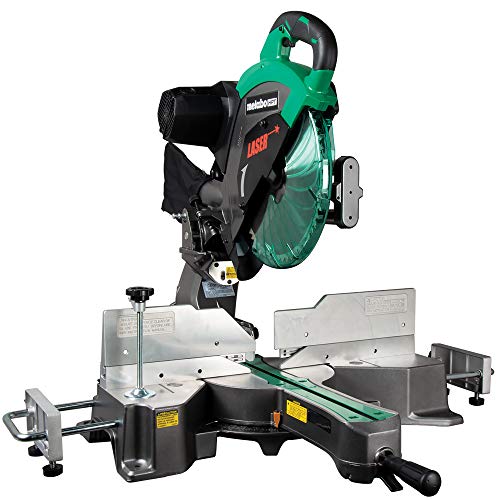
The Metabo HPT C12RSH2S is built around the same problem the Bosch addresses — rear clearance — and answers it with a compact slide system that the maker specifies as needing zero clearance behind the saw. That lets the C12RSH2S sit flush against a wall on a shallow bench while keeping a full 12-inch sliding cut, which makes it the natural shortlist entry for fixed benches in small workshops and for site work where the saw backs onto a wall or a van bulkhead.
Its stated figures are the most detailed in this guide. The 15-amp motor runs at 4,000 RPM no-load, the highest speed listed here, and the crosscut capacity is given as 4-1/8 x 12-1/4 inches at 0 degrees — enough for common dimensional lumber on edge and for wide boards laid flat, which is the work a 12-inch slider is bought to do. At 59.5 lb it is a substantial saw to move, but that weight also keeps it planted during long cuts. The laser marker system projects the cut line onto the stock for alignment before the blade spins up.
Because the slide mechanism is compact rather than a long rail pair, the saw gives up the extended reach that the longest rail sliders use for their widest cuts, in exchange for its footprint. For most stock widths in trim, framing and furniture work, the stated capacity covers the job; users who routinely cut very wide panels flat should compare the capacity figure against their widest board before choosing.
Specs
– Blade: 12-inch
– Motor: 15-amp
– No-load speed: 4,000 RPM
– Design: sliding compound, compact slide with zero rear clearance
– Crosscut capacity: 4-1/8 x 12-1/4 inches at 0 degrees
– Cut-line guide: laser marker system
– Weight: 59.5 lb
Pros
– Zero rear clearance slide design fits against a wall
– Highest no-load speed in this guide at 4,000 RPM
– Stated crosscut capacity of 4-1/8 x 12-1/4 inches at 0 degrees
Cons
– At 59.5 lb it is heavy to carry between sites
– Compact slide trades maximum reach for its small footprint
DEWALT DWS779 12-Inch Double Bevel Sliding Compound Miter Saw

The DWS779 is the DWS780’s sibling on the same DEWALT platform: a 12-inch double-bevel sliding compound miter saw with a 15-amp motor, the same rail-sliding head arrangement and the same two-way bevel capability. The difference between the two saws is the cut-line system — the DWS779 is built without the XPS LED shadow light that defines the DWS780.
That single omission defines who should buy it. Users who align cuts by eye against a pencil line, who work from stops and jigs for repeated lengths, or who simply never took to a projected line will not miss the light, and they get the same underlying saw for the purpose. The sliding head still covers wide crosscuts, the head still bevels in both directions for moulding and trim, and the saw still suits the same mix of framing, decking and furniture work as its sibling.
The honest caveat runs the other way: the shadow line is genuinely useful on fine trim, where the difference between splitting a line and covering it shows in the finished joint. A buyer whose work is mostly finish carpentry should think carefully before giving it up, because it cannot be added to the DWS779 later as a factory system. For rough and general work, though, this is the same platform with one feature left off, and for many workshops that is the right trade.
Specs
– Blade: 12-inch
– Motor: 15-amp
– Design: double-bevel sliding compound
– Cut-line guide: none fitted (no XPS light system)
Pros
– Same double-bevel sliding DEWALT platform as the DWS780
– 15-amp motor and 12-inch blade for wide crosscuts and two-way bevels
– Simpler specification for users who align cuts without a projected line
Cons
– No XPS shadow light, and it cannot be retrofitted as a factory system
– Rail slide needs clear space behind the saw, like its sibling
How to Choose
Begin with the space behind the bench, because it rules out more saws than any cutting figure. A rail slider such as either DEWALT needs room for the head to travel backwards through the full cut. Where that room does not exist, the Bosch glide arm and the Metabo HPT compact slide exist precisely to remove the requirement: both keep the saw close to a wall. Measure the bench depth and the wall position before comparing anything else.
Next, match capacity to the widest stock cut regularly. All five saws here carry a 12-inch blade and a sliding head, which puts wide boards, decking and shelving within reach, but stated figures differ: the Metabo HPT lists 4-1/8 x 12-1/4 inches at 0 degrees. If a workshop cuts one particular wide board every week, compare that board against the stated capacity of the saw on the shortlist rather than assuming every 12-inch slider reaches the same width.
Then decide how bevels will be handled. Every saw in this guide bevels in both directions, which is the right specification for crown moulding, base trim and picture-frame work: the workpiece stays against the fence, and only the head changes side. Single-bevel saws save nothing that matters at this size once long trim lengths are involved.
Choose a cut-line system by workshop light and by habit. A shadow line, as on the DWS780, shows the blade’s own position and stays readable in bright conditions. A laser, as on the Makita and the Metabo HPT, draws a clear line on rough stock but should be checked for alignment after the saw is moved. Buyers who cut to stops and fences for repeated lengths may find the DWS779’s plain setup entirely sufficient.
Finally, weigh the saw — literally. A fixed workshop saw can be as heavy as it likes, and weight damps vibration; the Metabo HPT at 59.5 lb is a bench saw first. A saw that travels to site work every week should be judged on how it carries as much as how it cuts, and on whether its slide or arm locks down securely for transport.
FAQs
Is a 12-inch sliding saw worth choosing over a 10-inch model?
For wide stock, yes. The larger blade combined with a sliding head widens the crosscut and deepens the cut compared with a 10-inch saw, which is what work on decking, wide shelving boards and stair treads calls for. A 10-inch saw remains lighter and suits narrow trim work, but the capacity difference is the reason the 12-inch class exists.
Which of these saws can sit against a wall?
Two of the five are designed for it. The Bosch GCM12SD folds its head forward on the Axial-Glide arm instead of sending rails backwards, and the Metabo HPT C12RSH2S uses a compact slide specified for zero rear clearance. The two DEWALT rail sliders need open space behind the saw for the head to travel, so they suit deeper benches or open workshop layouts.
Should I choose a laser or a shadow light for the cut line?
Choose by light and by stock. The DWS780’s XPS shadow light shows the actual blade position and reads well in bright workshops. The lasers on the Makita LS1219L and the Metabo HPT C12RSH2S draw a defined line that is easy to follow on rough or dark stock, provided alignment is checked after the saw has been moved. Neither system changes the cut itself; both exist to place the cut where the pencil line says it belongs.
Conclusion
For most workshops, the DEWALT DWS780 is the pick: a 15-amp double-bevel slider whose XPS shadow line removes the guesswork from fine cuts, supplied with blade, clamp and dust bag. The Bosch GCM12SD is the runner-up and the better choice where bench depth is limited, thanks to its folding glide arm. The Makita LS1219L suits laser-guided work, the Metabo HPT C12RSH2S pairs zero rear clearance with the most detailed stated capacity in the guide, and the DEWALT DWS779 gives up the light while keeping the same platform. Measure the bench depth first, then choose by cut-line system.