Key takeaways
- Compare four 14-inch abrasive chop saws for cutting steel, rebar and angle iron. Motor power, wheel speed, vise design and weight explained before you buy.
Cutting a length of angle iron or a bundle of rebar is a different job from cutting timber, and the saw you reach for should reflect that. An abrasive chop saw spins a fiber-reinforced disc against steel, grinding through the metal with friction and heat rather than slicing it with teeth. The real decision is not which saw looks toughest on a shelf, but which combination of motor power, wheel speed, vise grip and weight matches the steel you cut most often and the place you cut it.

This guide covers four 14-inch abrasive chop saws chosen from their Amazon listings, from a cordless Milwaukee built for jobsites without power to a corded DEWALT aimed at steady shop work. It suits fabricators cutting stock to length, DIY builders framing with steel studs or angle iron, and anyone who needs clean, square cuts through rebar, pipe and flat bar without reaching for a grinder every time.
Quick Picks
As an Amazon Associate we earn from qualifying purchases
| Product | Best for | Key spec from title |
|---|---|---|
| Milwaukee M18 FUEL 18V Brushless Cordless 14 in Abrasive Cut-Off Saw | Cutting steel away from mains power | 18V brushless cordless, 14 in wheel |
| VEVOR Chop Saw 14 in Abrasive Wheel | Occasional garage cutting on a budget | 2000W motor, 3500 RPM |
| PORTER-CABLE PCE700 | Everyday steel cutting with a lighter saw | 15-amp, 14 in, 3800 RPM |
| DEWALT D28730 14 in | Repeated shop cuts with a firm vise | 2300W motor, 15 Amp, Quick-Lock vise |
How to Choose
Motor Power and Wheel Speed
Power decides how quickly the wheel bites into steel and how well it holds speed under load. A 15-amp corded motor or a 2000W-plus rating generally keeps the disc spinning through thick angle iron instead of bogging down halfway through the cut. No-load speed matters too, because a wheel that spins faster cuts faster, but it also wears faster and throws more sparks. Compare the rated speed on the listing rather than trusting a roundup figure, since retailer pages sometimes disagree. A cordless saw trades raw power for freedom from cords, so check its voltage platform and whether the battery and charger are included before you assume it is ready to cut.
Vise and Fence Quality
A chop saw is only as accurate as the clamp holding the workpiece. A weak vise lets steel shift mid-cut, which produces angled ends, binds the wheel and shortens its life. Look for a quick-release clamp that locks the stock firmly without needing a wrench every time you reposition it. A pivoting fence that adjusts to 45 degrees opens up miter cuts on angle iron and flat bar, and it should lock solidly at the angle you set. The base matters as well: a heavy-duty steel base resists flexing when you press the handle down, and a spark deflector keeps hot debris directed away from you and the workbench.
Wheel Size and Cutting Capacity
Nearly every serious abrasive chop saw in this class runs a 14-inch wheel, which sets the maximum depth and width of steel it can cut in one pass. That size handles most rebar, angle iron, pipe and flat bar a home fabricator or small shop will meet. What changes between models is not the wheel diameter but how much of it you actually use, since the wheel wears down with every cut and a smaller wheel cuts less deep. Check whether the saw ships with a wheel included or whether you need to buy one separately, and remember that abrasive discs are consumables: budget for replacements and never fit a cracked or damaged disc.
Weight and Jobsite Handling
A chop saw lives in two worlds, and weight pulls in opposite directions for each. On a workbench, a heavier saw stays planted, vibrates less and cuts straighter. On a jobsite, every extra pound matters when you carry the saw up stairs, across a yard or into a truck bed. The models in this guide range from 32 pounds to nearly 46 pounds, and that gap is noticeable after a day of moving between cutting stations. If the saw will move often, a lighter corded model or a cordless unit with a carry handle makes sense. If it stays in one spot, choose stability over portability and let the heavier frame work for you.
The 4 Best Options
Milwaukee M18 FUEL 18V Brushless Cordless 14 in Abrasive Cut-Off Saw
The Milwaukee is the only cordless saw in this group, and that fact shapes who should buy it. It runs on the M18 battery platform, so anyone invested in Milwaukee tools can put a charged battery in and start cutting steel wherever the work happens, with no extension cord and no generator. The brushless motor spins the 14-inch wheel at 4000 RPM, the fastest no-load speed here, and the saw is built for cutting rebar, angle iron and pipe on jobsites where mains power is far away or unavailable. Its weight is the trade-off, since the bare tool alone comes in at 45.8 pounds before you add a battery.
Specs
- 18V brushless cordless motor
- 14 in abrasive wheel
- 4000 RPM no-load speed
- 45.8 lb
- Model 2990-20
- Tool-only, battery and charger not included
Best for: Cutting steel on jobsites without access to mains power, especially for users who already own M18 batteries.
Watch out for: This is a tool-only listing, so confirm you have a compatible M18 battery and charger, and expect a heavy carry at 45.8 pounds before the battery goes in.
VEVOR Chop Saw 14 in Abrasive Wheel
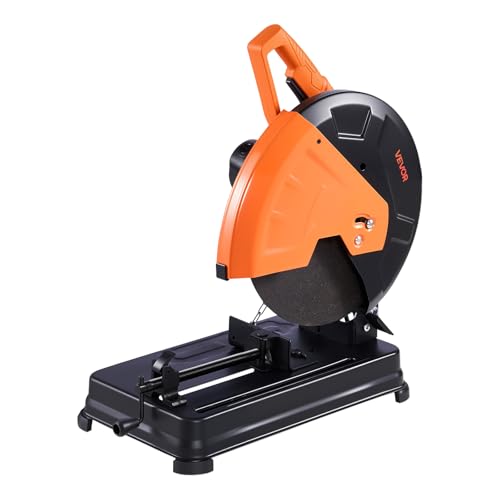
The VEVOR is the straightforward pick for someone who cuts steel occasionally and wants a full-size saw without a premium price tag. Its 2000W motor drives a 14-inch abrasive wheel at 3500 RPM, enough power for rebar, angle iron and flat bar in a home garage or workshop. The cutting angle adjusts from 0 to 45 degrees, so miter cuts on angle iron are possible without a separate setup. It is a no-frills machine: the value is in the motor and the wheel size, not in extras, and buyers who cut steel a few times a month rather than daily will find that trade-off easy to live with.
Specs
- 2000W motor
- 14 in abrasive wheel
- 3500 RPM
- 0 to 45 deg adjustable cutting angle
- Model J1G-ZB-355C-1
Best for: Occasional garage and workshop cutting where a full-size 14-inch saw is needed at a modest outlay.
Watch out for: Confirm the model number J1G-ZB-355C-1 and the 2000W motor on the listing, since a different VEVOR 2300W variant has been reported out of stock.
PORTER-CABLE PCE700

The PORTER-CABLE PCE700 is the lightest saw in this guide at 32 pounds, and that weight difference is felt every time the saw moves from a shelf to a bench or into a truck. A 15-amp motor spins the 14-inch wheel at 3800 RPM, giving it enough speed and power for routine cuts through steel stock, rebar and pipe. The 45-degree miter adjustment and quick-release clamp make setup fast, the spark deflector directs debris away from the operator, and the heavy-duty steel base keeps the saw steady during a cut. A 3-year limited warranty backs the tool, which is useful reassurance for a saw that will see regular use.
Specs
- 15-amp motor
- 14 in abrasive wheel
- 3800 RPM
- 32 lb
- 45 deg miter adjustment
- Quick-release clamp
- Spark deflector
- Heavy-duty steel base
- 3-year limited warranty
Best for: Everyday steel cutting where a lighter saw that moves easily between the bench and the jobsite matters.
Watch out for: At 32 pounds it is light for this class, so clamp the workpiece firmly and let the wheel do the work rather than forcing the handle down.
DEWALT D28730 14 in
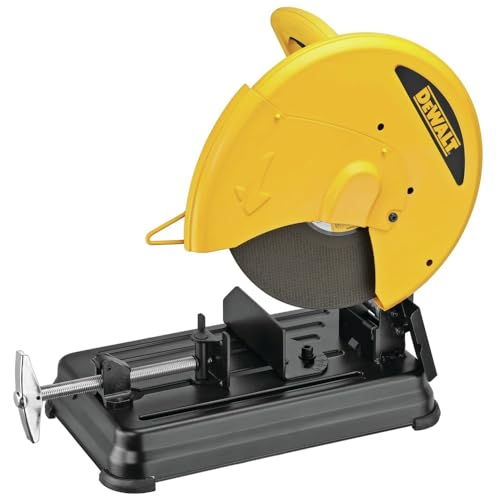
The DEWALT D28730 is built around its vise, and that is what sets it apart for anyone making repeated cuts in a shop. The Quick-Lock vise clamps stock fast and holds it square, while the 45-degree pivoting fence handles angled cuts on angle iron and flat bar without fiddly repositioning. A 2300W, 15-amp motor drives the 14-inch wheel, and the saw ships with one abrasive wheel and a wrench, so it is ready to cut out of the box. At 35 pounds it sits between the light PORTER-CABLE and the heavy Milwaukee, heavy enough to stay planted on a bench yet still movable when the job moves.
Specs
- 2300W motor
- 15 Amp
- 14 in abrasive wheel
- Quick-Lock vise
- 45 deg pivoting fence
- 35 lb
- Includes 1 abrasive wheel and wrench
Best for: Repeated shop cuts where a fast, firm vise and a pivoting fence save time on every piece.
Watch out for: Check the no-load speed on the Amazon listing before ordering, since the DEWALT manual and some retailer pages state different figures for this model.
Which One Fits Your Situation
You Cut Steel Where There Is No Power
Choose the Milwaukee M18 FUEL. It is the only saw here that runs without a cord, and its 4000 RPM wheel speed is the fastest in the group. The cost is weight and the need for M18 batteries, but if your cutting happens on a site with no outlet nearby, no corded saw competes. Keep a spare battery charged, since abrasive cutting draws hard on the pack.
You Cut Steel a Few Times a Month in the Garage
Choose the VEVOR. Its 2000W motor and 3500 RPM wheel handle rebar, angle iron and flat bar for typical home projects, and the 0 to 45 degree angle adjustment covers miter cuts. It is the practical choice when the saw spends more time on a shelf than on a bench, and you want full-size capacity without paying for features you will rarely use.
You Move the Saw Between the Bench and the Jobsite
Choose the PORTER-CABLE PCE700. At 32 pounds it is the lightest saw in this guide, and the quick-release clamp plus 45-degree miter adjustment make setup quick wherever you set it down. The spark deflector and heavy-duty steel base add safety and stability, and the 3-year limited warranty is a solid backup for a saw that travels.
You Make the Same Cut Again and Again in a Shop
Choose the DEWALT D28730. The Quick-Lock vise and 45-degree pivoting fence are built for repetition: clamp, cut, release, repeat, with the stock held square every time. The 2300W motor keeps the wheel turning through thick stock, and the included wheel and wrench mean the saw is ready to work as soon as it arrives.
Common Mistakes
- Cutting wood with an abrasive chop saw: these wheels are made for steel, and wood can grab, kick and burn instead of cutting cleanly.
- Forcing the handle down to speed up a cut: pressing hard overheats the wheel, wears it out fast and can bind it in the kerf, so let the disc grind at its own pace.
- Skipping the vise and holding stock by hand: a loose piece can shift, jam the wheel or fly free, and the cut will come out angled anyway.
- Using a worn or cracked abrasive wheel: a disc that has worn small cuts less deep, and a cracked disc is dangerous, so inspect it before every session and replace it when it is damaged.
- Cutting without eye protection and a clear spark path: abrasive cutting throws a stream of hot sparks, so wear safety glasses and keep flammable material away from where the sparks land.
Frequently Asked Questions
Can an abrasive chop saw cut wood?
No, and it should not be used that way. Abrasive wheels are designed to grind through steel, rebar and angle iron, and wood behaves very differently under a spinning abrasive disc. It can grab, smoke and kick back, and the cut will be rough and scorched. For timber, use a saw with a toothed blade made for wood, such as a miter saw or circular saw.
How long does an abrasive wheel last?
It depends on how much steel you cut and how thick it is. Abrasive wheels wear down with every cut, and thick stock, hard steel and heavy pressure all shorten their life. A wheel that has worn noticeably smaller cuts less deep, so check its diameter before starting a job that needs full depth. Keep spare wheels on hand so a worn disc never tempts you to keep cutting.
Should I buy a cordless or corded abrasive chop saw?
Corded saws suit a bench or workshop where power is always nearby, since they run as long as you need them and their motors hold speed under load. Cordless saws suit jobsites without power and users already on that battery platform, but they add weight and need charged batteries. If the saw rarely leaves the shop, a corded model is the simpler choice.
What safety gear do I need when using a chop saw?
Wear safety glasses or a face shield, since abrasive cutting throws sparks and small fragments of metal and wheel material. Gloves protect your hands when handling freshly cut steel, which comes off the saw hot and sharp. Work in a clear area, clamp the stock firmly in the vise, and keep flammable material well away from the stream of sparks.