Our Short List of 3

- Best for: Home workshops cutting thick trim and framing lumber with a 12-inch blade.
- Blade: 12 in
- Motor: 15 amp
- Type: single-bevel compound miter saw
- Model: DWS715
- Best for: Renters and small garages needing a light saw that stores on a shelf.
- Blade: 10 in, 24T TCT
- Motor: 15 amp, 5,000 RPM no-load speed
- Miter range: 0 to 52 degrees
- Bevel range: 0 to 45 degrees, single bevel
- Best for: Wide trim, deck boards, and shelving cut in one pass.
- Blade: 10 in
- Motor: 15 amp, 4,800 RPM no-load speed
- Type: dual-bevel sliding compound
- Crosscut capacity: 2×12 at 90 degrees; 2×8 at 45 degrees
All 4 Picks at a Glance
| Product | Specs | Action |
|---|---|---|
| DEWALT DWS715 |
| Check price on Amazon |
| Metabo HPT C10FCGS |
| Check price on Amazon |
| SKIL MS6305-00 |
| Check price on Amazon |
 Metabo HPT C10FCG2 |
| Check price on Amazon |
Key takeaways
- Looking for the best economical miter saws for home DIY? Compare four budget-friendly compound and sliding saws on capacity, bevel range, and power.
Choosing an economical miter saw is a decision about which trade-offs you can live with, not about finding the lowest sticker on the shelf. A saw that drifts off square wastes more lumber than it ever saves, and a weak motor that stalls in thick trim turns a simple weekend project into a slow wrestling match. The real question is where the maker saved money: a shorter fence, a basic blade, a missing cut line, or a lighter table that flexes under a long board.
This guide fits homeowners cutting baseboards, deck boards, and shelving, renters setting up a first small workshop, and DIYers replacing a worn saw without paying for contractor capacity they will never use. Each pick below is drawn from its Amazon listing, with blade size, motor, bevel range, and cutting capacity taken from the published specifications.
Quick Picks
As an Amazon Associate we earn from qualifying purchases
| Product | Best for | Key spec from title |
|---|---|---|
| DEWALT DWS715 | Thick trim and framing lumber | 12-inch, 15-amp single-bevel compound |
| Metabo HPT C10FCGS | A first saw for a small workshop | 10-inch, 15-amp compound, 0-52 degree miter range |
| SKIL MS6305-00 | Wide boards in a single pass | 10-inch dual-bevel sliding compound, LED shadow line |
| Metabo HPT C10FCG2 | Finish cuts on painted trim | 10-inch, 15-amp single-bevel compound, 40T blade |
How to Choose
Blade Size and Cutting Capacity
A 10-inch saw handles most home jobs: trim, shelving, deck boards, and framing lumber up to a 2×8 or 2×10 in a single pass, depending on the model. A 12-inch saw adds depth for thicker stock and taller baseboards standing upright, which matters if you cut chunky crown or 4×4 posts. Sliding rails stretch crosscut width further, letting a 10-inch saw cut a 2×12 flat, but the rails need clear space behind the saw and add weight. Measure the widest board you cut regularly, then buy the capacity for that board plus a little headroom, not the biggest saw in the aisle.
Single Bevel or Dual Bevel
A single-bevel saw tilts one way, usually to the left, so mirrored bevel cuts force you to flip the board and re-align it. That is fine for straight crosscuts and simple miters, which cover most home projects. A dual-bevel head tilts both ways, so crown molding and paired trim pieces go faster with fewer setup mistakes. Dual bevel costs more and adds weight, so weigh it against your real work: if you cut crown molding or bevel both edges of a board in the same session, dual bevel earns its keep; if you mostly cut deck boards square, a single-bevel saw leaves money for a better blade.
Motor Power and Blade Speed
Most economical miter saws run a 15-amp corded motor, which is plenty for pine, plywood, and standard trim. No-load speed tells you how fast the blade spins before it meets wood: higher speeds generally leave cleaner edges in soft material, while a steady feed rate matters more than raw speed in dense hardwood. Tooth count shapes the finish too. A 24-tooth blade rips through framing lumber quickly and leaves a rougher edge, while a 40-tooth blade cuts slower and leaves a smoother face on painted trim. Start with the blade the saw ships with, then keep a fine-finish blade on hand for visible work.
Accuracy Hardware: Fence, Stops, and Cut Line
The fence, the detent stops, and the cut line decide whether your angles repeat from the first board to the last. Tall, straight fences support long trim without rocking, and positive stops at common angles such as 0, 15, 22.5, 30, and 45 degrees let you return to a setting by feel instead of squinting at a scale. A shadow line or laser shows exactly where the blade will land, which helps when the cut must meet a pencil mark on painted stock. On an economical saw, check these three details in the listing before anything else, because a strong motor cannot rescue a fence that flexes or a scale that drifts.
The 4 Best Options
DEWALT DWS715
- Best for: Home workshops cutting thick trim and framing lumber with a 12-inch blade.
- Blade: 12 in
- Motor: 15 amp
- Type: single-bevel compound miter saw
- Model: DWS715
Home workshops cutting thick trim and framing lumber with a 12-inch blade.
Single bevel only, so mirrored bevel cuts mean flipping the board; the saw is heavy, so give it a fixed bench spot.
The DWS715 is the straightforward pick for a home workshop that needs 12-inch capacity without sliding rails or dual-bevel complexity. Its 15-amp motor drives a full-size 12-inch blade through thick trim and framing lumber, and the single-bevel head keeps the mechanism simple and the saw easy to square. The tall sliding fence supports crown molding standing upright, and the dust system hooks to a bag or a shop vacuum so the bench stays workable. It is heavy for its class, so plan a fixed spot on a bench or a stand rather than carrying it room to room.
Watch out for: Single bevel only, so mirrored bevel cuts mean flipping the board; the saw is heavy, so give it a fixed bench spot.
Metabo HPT C10FCGS
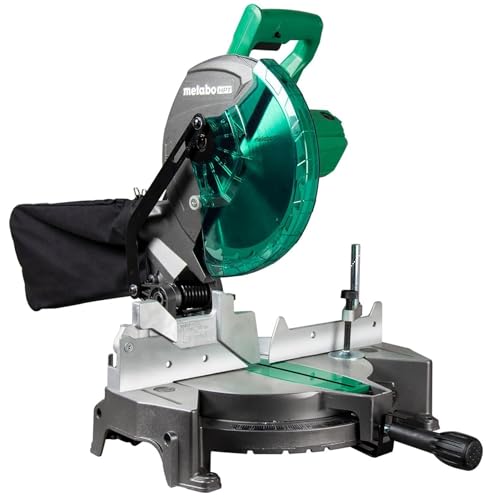
- Best for: Renters and small garages needing a light saw that stores on a shelf.
- Blade: 10 in, 24T TCT
- Motor: 15 amp, 5,000 RPM no-load speed
- Miter range: 0 to 52 degrees
- Bevel range: 0 to 45 degrees, single bevel
Renters and small garages needing a light saw that stores on a shelf.
No cut line guide, so mark cuts carefully and check the blade against the pencil line; single bevel only.
The C10FCGS is the lightest full-size saw in this group, and that is its whole appeal. A 15-amp motor spins the 10-inch blade at 5,000 RPM, so it moves through pine and plywood without bogging down, and the large table supports long boards better than the compact saws in this class. The miter range runs 0 to 52 degrees, and thumb-actuated positive stops make repeat angles quick to set. At a weight a single person can lift onto a bench with one hand free, it suits renters and small garages where the saw lives on a shelf between projects.
Watch out for: No cut line guide, so mark cuts carefully and check the blade against the pencil line; single bevel only.
SKIL MS6305-00
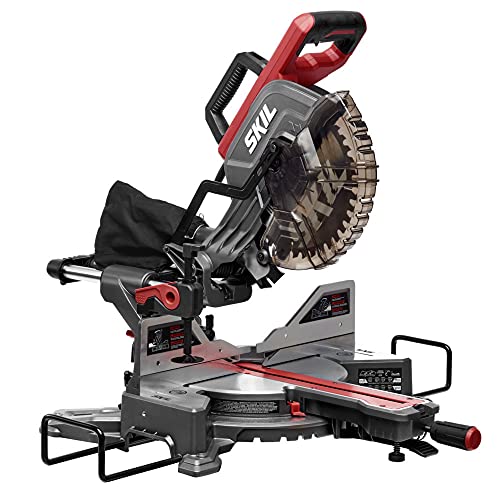
- Best for: Wide trim, deck boards, and shelving cut in one pass.
- Blade: 10 in
- Motor: 15 amp, 4,800 RPM no-load speed
- Type: dual-bevel sliding compound
- Crosscut capacity: 2×12 at 90 degrees; 2×8 at 45 degrees
Wide trim, deck boards, and shelving cut in one pass.
Needs rear clearance for the sliding rails; heaviest pick here at 39.4 pounds.
The MS6305-00 is the most capable saw in this group for the money a home buyer spends, because it pairs sliding rails with a dual-bevel head. The 10-inch blade crosscuts a 2×12 flat at 90 degrees and a 2×8 at 45 degrees, so wide deck boards and shelving go through in one pass. The LED shadow line shows the cut before the blade drops, and 11 positive stops cover the angles trim work actually uses. At 39.4 pounds it is the heaviest saw here, so it belongs on a bench with clear space behind it for the rails rather than in a closet you drag it from.
Watch out for: Needs rear clearance for the sliding rails; heaviest pick here at 39.4 pounds.
Metabo HPT C10FCG2
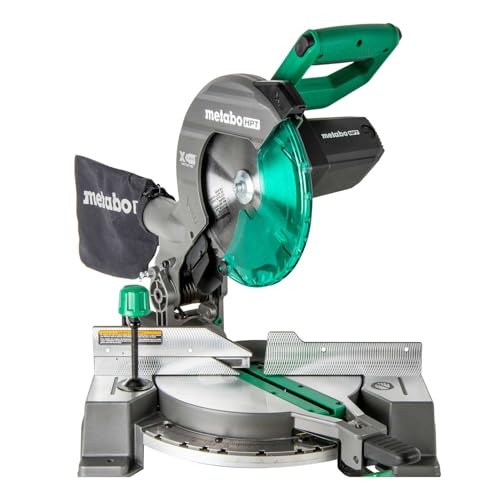
- Best for: Painted trim and finish work where the cut edge stays visible.
- Blade: 10 in, 40T TCT
- Motor: 15 amp
- Type: single-bevel compound miter saw
- Cut line: Xact Cut LED shadow line
Painted trim and finish work where the cut edge stays visible.
Single bevel only, so mirrored bevels need the board flipped; a newer listing with a shorter history on Amazon.
The C10FCG2 is the updated version of the classic Metabo HPT 10-inch compound saw, and the upgrades show up where finish work happens. The Xact Cut LED shadow line marks the cut line on the board, and the included 40-tooth blade leaves a smoother edge on painted trim than the 24-tooth blade on the older model. The 15-amp motor and 0-to-45-degree single-bevel range stay the same, so it keeps the simple, light character that made the original a workshop staple. Pick this one when most of your cuts will be seen after the paint dries.
Watch out for: Single bevel only, so mirrored bevels need the board flipped; a newer listing with a shorter history on Amazon.
Which One Fits Your Situation
Your First Saw for a Small Workshop
Take the Metabo HPT C10FCGS. It is light enough to lift onto a bench and store on a shelf, the controls are simple, and the 10-inch blade covers trim, shelving, and deck boards. You give up the shadow line and dual bevel, but for a first saw those are conveniences, not requirements, and the money stays in your pocket for blades and clamps.
Wide Boards and Trim in One Pass
Take the SKIL MS6305-00. Sliding rails let the 10-inch blade crosscut a 2×12 flat, and the dual-bevel head handles mirrored crown cuts without flipping the board. The LED shadow line keeps the blade on the pencil mark, which matters when a miscut wastes a long piece of trim. Give it a fixed bench spot with room behind for the rails.
Thick Stock and Framing Lumber
Take the DEWALT DWS715. The 12-inch blade and 15-amp motor cut deeper than any 10-inch saw here, so thick baseboards, chunky crown, and framing lumber go through without a second pass. The tall sliding fence supports long pieces standing upright. Accept the single bevel and the weight, and keep the saw on a bench or a stand.
Finish Work Where the Edge Shows
Take the Metabo HPT C10FCG2. The 40-tooth blade leaves a smoother face on painted trim, and the Xact Cut shadow line shows the cut before the blade touches the wood. It keeps the light, simple build of the older model, so it stores easily and sets up fast for a Saturday of baseboards and door casing.
Common Mistakes
- Buying the biggest blade size instead of the capacity your boards need, then struggling to store a saw that never leaves the bench.
- Skipping the bevel check: a single-bevel saw means flipping long boards for mirrored cuts, which wastes time on crown molding.
- Forgetting rear clearance for sliding rails, then finding the saw cannot slide fully against a wall.
- Cutting painted trim with the rough blade the saw ships with, then sanding every edge the blade tore.
- Ignoring dust collection until the first indoor cut coats the whole room in fine dust.
Frequently Asked Questions
What size miter saw is enough for home use?
A 10-inch saw covers most home work, including trim, shelving, and deck boards, and it costs less and weighs less than a 12-inch model. Step up to 12 inches only when you regularly cut thick baseboards, tall crown standing upright, or framing lumber that a 10-inch blade cannot reach in one pass.
Do I need a sliding miter saw?
Only when your boards are wider than a fixed saw can crosscut in one pass. Sliding rails let a 10-inch saw cut a 2×12 flat, which helps with wide shelving and deck boards. If you mostly cut trim and framing lumber, a fixed saw is lighter, simpler, and easier to store, and it leaves room in the budget for a better blade.
Is a single-bevel saw enough for crown molding?
Yes, for most home crown work, as long as you are willing to flip the board for mirrored cuts. A single-bevel saw handles one side of every compound angle; you turn the piece over for the other side. Dual bevel saves setup time and reduces mistakes on long runs, but it is a convenience, not a requirement, for a weekend of trim.
Can an economical miter saw cut hardwood?
Yes, with the right blade and a steady feed. A 15-amp motor handles oak and maple trim when the blade is sharp and the cut is not forced. Use a fine-tooth blade for hardwood, let the blade reach full speed before it meets the wood, and feed slowly so the motor holds its pace through the cut.