Key takeaways
- Compare the best band saws for cutting glass, from a compact diamond-blade table saw to tall-clearance models built for stained glass, tile, and stone.
A glass band saw is not a wood saw fitted with a different blade. Cutting glass means grinding through a brittle sheet with a diamond-coated loop blade and a steady stream of water, and the wrong machine chips edges, cracks sheets, or stalls halfway through a curve. The real decision is how much control the saw gives you over blade speed, water flow, and tension while the glass moves through the cut, because that control is what keeps a fragile piece intact.

This guide is for stained glass artists cutting curves and inside corners, mosaic makers shaping small pieces, and lapidary hobbyists working glass alongside stone and coral. Every saw below was picked from the model name and specifications shown on its Amazon listing, with the blade type, voltage, and cutting clearance checked against what the listing states.
Quick Picks
As an Amazon Associate we earn from qualifying purchases.
| Product | Best for | Key spec from title |
|---|---|---|
| Inland Craft DB-100 | Intricate stained glass curves | Diamond blade band, 115V only |
| Gryphon C40 TALL | Tall pieces and bottles | Extended 5.56-inch clearance |
| MicroLux Variable Speed Mini Band Saw | Small mixed-material hobby work | Variable speed mini band saw |
| Gryphon C40-CR AquaSaw XL | 220V workshops and salt-water material | 220V international model |
How to Choose
Blade type decides what the saw can cut
A diamond-coated loop blade is the part that makes a band saw a glass saw. A toothed steel blade meant for wood tears at glass instead of grinding through it, and the edge comes away rough or cracked. Check the listing for the words diamond blade and for the blade length and width, because a saw that takes a standard 37-inch or 42-inch diamond loop gives you an easy path to a replacement when the coating wears down. A saw that ships with a wood or metal blade and calls glass cutting an optional extra still needs that diamond blade bought separately, so treat the blade in the box as only the beginning, not the whole story.
Speed control keeps thin glass from chipping
Glass breaks when the blade moves too fast for the thickness in front of it, and it drags when the blade moves too slowly. A variable-speed motor lets you slow down for thin stained glass and speed up for thicker slabs, which is why the saws in this guide list a speed range instead of a single number. Look for the range on the listing and think about the glass you cut most: delicate sheets under 3 mm need the low end of the range, while fused pieces and thick architectural glass need the power to hold speed under load. A single-speed saw can still work, but it leaves you with one setting for every thickness you will ever cut.
Water cooling is not optional
Cutting glass dry builds heat at the blade, and heat turns a clean line into a crack that runs across the sheet. Every saw in this guide uses water at the cutting point, either from a recirculating tray under the table or from a gravity-fed clean-water system. Before you buy, check how the water reaches the blade and how easy the tray is to empty and clean, because a tray that is awkward to drain gets skipped, and a skipped tray means dry cuts. Keep the water level topped up during long sessions, and change it when it turns cloudy with glass dust so the blade keeps cutting instead of grinding through grit.
Clearance and table size set the size of your work
Clearance is the gap between the table and the upper blade guide, and it decides how tall a piece can pass through the saw. A standard glass band saw clears a little over two inches, which handles flat stained glass and most mosaics, while a tall model clears four inches or more and takes bottles and thicker slabs. The table matters too: a larger platform steadies a big sheet, and a small table forces you to support the overhang by hand, which invites wobble and uneven lines. Measure the tallest piece you plan to cut and the bench space you have, then match both numbers to the listing before you decide.
The 4 Best Options
Inland Craft DB-100
The DB-100 is the compact tabletop machine that stained glass makers reach for when the work is small and detailed. Its diamond band blade runs through a clean-water coolant system, and the variable-speed motor lets you drop the pace for thin sheets and raise it for thicker pieces without changing machines. The 13 by 10 by 18 inch frame sits on a small bench and leaves room for patterns and offcuts around it, which matters in a home studio where the bench is also the layout table. It cuts glass, stone, tile, coral, and mosaics, so one machine covers the curved shapes that a straight scoring tool cannot follow.
Specs
- Variable speed from 800 to 3,400 rpm
- Permanent magnet DC motor, 115V only
- Built-in clean-water coolant system
- Dimensions: 13 x 10 x 18 inches
- Includes a diamond band saw blade
- Cuts glass, stone, tile, coral, and mosaics
Best for: Stained glass artists cutting tight curves and small detailed pieces on a small bench.
Watch out for: The listing is 115V only, so check your power supply first; also confirm how many blades are included, because some listings show one diamond blade and others show three blades.
Gryphon C40 TALL
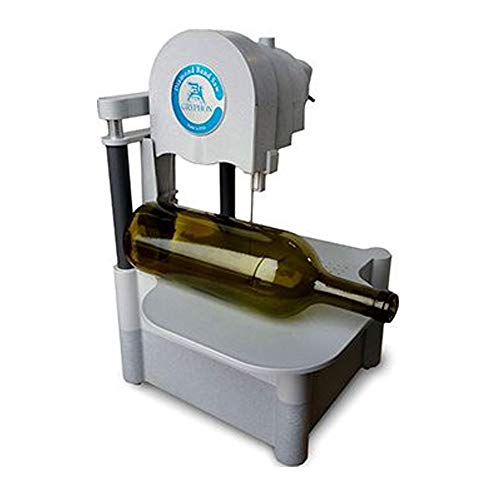
The C40 TALL is the standard Gryphon C-40 raised up for taller work. Its 42-inch stainless steel diamond blade travels at 40 mph, and the extended frame clears 4.5 inches with the blade guide in place, or 5.56 inches with the guide removed, so bottles and thick slabs pass through where a standard-height saw would stop. The motor is a 1/3 hp direct-drive unit mounted on top, away from the water tray, which keeps the design simple and the moving parts few. It cuts glass, stone, tile, and ceramics, and it is the saw to look at when your pieces keep outgrowing the clearance of a tabletop machine.
Specs
- 42-inch stainless steel diamond blade included
- Blade speed: 40 mph
- Clearance: 4.5 inches, or 5.56 inches with the blade guide removed
- Motor: 1/3 hp direct drive
- Weight: 18 lb
- 1-year warranty
Best for: Cutting bottles, tall pieces, and thick slabs that need more clearance than a standard saw.
Watch out for: The taller frame needs more bench height and space; check the 42-inch replacement blade for your material before ordering.
MicroLux Variable Speed Mini Band Saw
The MicroLux mini band saw is the machine in this guide built for a hobby bench where space is tight and projects keep changing. Its 100-watt motor runs from 425 to 650 feet per minute, and the 13 lb frame is 15 by 20 by 11 inches, so it moves off the bench between sessions. The Amazon listing names glass and metal as the surface recommendation, and the saw handles wood, plastic, stone, tile, and bone as well. Glass work needs the optional diamond blade and cooling set, which are sold separately, so plan for those parts when you compare this saw with the diamond-blade machines above.
Specs
- Model 82203, 100-watt motor
- Variable speed: 425 to 650 ft/min
- Dimensions: 15 x 20 x 11 inches; weight: 13 lb
- Includes a 41-7/8 inch blade, 14 tpi
- Surface recommendation: glass and metal
Best for: Small hobby benches where one compact saw handles glass, metal, wood, and plastic in turn.
Watch out for: Glass cutting needs the optional diamond blade and cooling set, which are sold separately from the saw.
Gryphon C40-CR AquaSaw XL Diamond Band Saw, 220V International
The C40-CR AquaSaw XL is the corrosion-resistant version of the Gryphon tall saw, built for salt-water material and coral as well as regular glass. Its stainless steel parts and sealed-bearing motor resist the corrosion that salt water brings, and the 42-inch stainless steel diamond blade travels at 40 mph for fast cuts through glass, stone, and tile. The tall frame gives the same extended clearance as the standard C40 TALL, so taller pieces fit through the guides. This is a specialist machine: it earns its place when your work crosses from stained glass into reef tanks and salt-water cutting, not when glass is the only material on the bench.
Specs
- 42-inch stainless steel diamond blade
- Blade speed: 40 mph
- Motor: 0.33 hp
- Corrosion-resistant build for salt-water material
- Cuts glass, stone, tile, and coral
- 220V international model
Best for: Workshops with 220V power that cut coral and salt-water material alongside glass.
Watch out for: This listing is the 220V international model, so confirm your power supply matches before ordering; the 110V version is a separate listing.
Which One Fits Your Situation
You cut stained glass patterns with tight curves
Pick the Inland Craft DB-100. Its variable speed and compact table suit small, detailed pieces, and the clean-water system keeps thin glass cool through inside corners. The diamond blade is included, so the saw is ready for glass from the first session. The 13 by 10 by 18 inch frame leaves bench room for patterns, and the saw also handles stone and tile when a mosaic mixes materials.
You cut bottles, tall pieces, or thick slabs
Pick the Gryphon C40 TALL. The 4.5-inch clearance, or 5.56 inches with the guide removed, takes bottles and thick slabs that a standard-height saw cannot pass. The 42-inch diamond blade and 40 mph blade speed keep those taller cuts moving instead of stalling halfway through. Measure your tallest piece first, because clearance is the number that decides whether this saw fits your work.
Your bench is small and your projects vary
Pick the MicroLux Variable Speed Mini Band Saw. The 13 lb frame and 15 by 20 by 11 inch size fit a crowded bench, and the variable speed covers wood, plastic, metal, and stone as well as glass. Remember to add the optional diamond blade and cooling set, because the saw as shipped is set up for general hobby cutting rather than glass alone.
You work with coral or salt-water material as well as glass
Pick the Gryphon C40-CR AquaSaw XL, and only if your workshop runs on 220V power. The corrosion-resistant build and sealed-bearing motor hold up to salt water, and the tall frame clears the same height as the standard C40 TALL. For glass-only work, the regular tall saw is the simpler match.
Common Mistakes
- Buying a wood band saw and expecting a standard toothed blade to cut glass: glass needs a diamond-coated loop blade and water at the cut.
- Running the saw dry or letting the water tray run low, which builds heat and cracks the sheet.
- Cutting at one fixed speed for every thickness instead of slowing down for thin stained glass.
- Forgetting to check the voltage on the listing, especially on international models built for 220V power.
- Choosing a saw by table size alone and finding the tallest piece does not fit through the blade guide.
Frequently Asked Questions
Can a regular band saw cut glass?
No. A regular band saw uses a toothed steel blade made for wood, and that blade tears at glass instead of grinding through it. Glass needs a diamond-coated loop blade with water cooling. A wood saw runs too fast and has no water tray, so the glass chips or cracks. Buy a saw built for glass, or fit a diamond blade and cooling set where the maker supports it.
How thick can a glass band saw cut?
Most glass band saws in this guide handle stained glass and sheets up to about a quarter inch thick with ease, and thicker slabs need a slower feed and a steady hand. The limit is usually the clearance between the table and the upper blade guide, not the blade itself. Check the clearance on the listing and compare it with your thickest piece before you buy.
Do I need water to cut glass on a band saw?
Yes. Water cools the diamond blade and carries glass dust away from the cut, which keeps the edge clean and stops heat cracks from running across the sheet. Every saw in this guide has a water system, either a recirculating tray or a gravity-fed supply. Top the water up during long sessions and change it when it turns cloudy, because dirty water grinds grit back into the cut.
What size diamond blade do glass band saws use?
It depends on the saw. The Gryphon C-40 models in this guide take a 37-inch diamond loop on the standard frame and a 42-inch loop on the tall frame, while the Inland DB-100 uses a shorter loop. Always match the blade length on the listing to your saw model, and use the blade the maker specifies, because a loop that is too long or too short will not tension correctly.