Key takeaways
- Four lightweight miter saws ranked by the weight each maker publishes, from 24.2 to 31 lbs, with blade, bevel, miter and capacity specs for each pick.
As an Amazon Associate, we earn from qualifying purchases made through links on this page.

A miter saw usually lives on a bench, but a large share of the work it does happens somewhere else: baseboard in a finished bedroom, laminate flooring in a hallway, deck boards in a yard, or a punch list spread across three floors of a house. For that kind of work the saw has to ride in a vehicle, come up stairs, and sit on a floor or a folding stand without a helper at the other end. Weight stops being a footnote in the spec table and becomes the figure that decides which saw gets loaded in the morning.
This guide ranks four miter saws by one measure above all others: the weight each maker publishes for its own saw. Every pick comes in at 31 pounds or less on that published figure. Three are corded 10-inch compound saws, the format that keeps weight down by skipping the sliding rails of bigger machines. The fourth is a cordless 7-1/4-inch sliding saw whose maker states its weight with a battery fitted, and it is flagged wherever that difference matters. Between them they cover trim carpentry, flooring, cabinet fitting and general site work, and each one is a current model sold on Amazon US.
Every specification below comes from the maker’s own product page, spec sheet or manual. Weights, capacities and angle ranges are quoted as the makers state them, because those documents are what a buyer can hold a brand to after the saw arrives.
What to Look for in a Lightweight Miter Saw
Published weight, and what it includes. Makers do not all weigh a saw the same way. A corded saw’s published weight is the bare machine. A cordless saw may be weighed with or without a battery, and a mid-size pack adds roughly two pounds on its own. Milwaukee states 28 pounds for its saw with a battery fitted, which is the honest figure to compare against the corded saws here, since a cordless saw cannot cut without the pack. Whichever saw you shortlist, check whether the number you are reading includes the battery, and look for molded carry handles on top or at the sides. Handles decide how a saw actually moves far more than a single pound either way.
Blade size against cutting capacity. Dropping from a 12-inch blade to a 10-inch blade is where most of the weight saving lives, and it costs crosscut width and depth. A fixed-head 10-inch saw crosscuts a 2×6 at best and handles baseboard up to roughly four and a quarter inches standing against the fence. A 7-1/4-inch blade cuts shallower still, which is why the small cordless pick in this guide adds a sliding head: the slide lets a small blade crosscut a 2×8 lying flat, trading depth for width.
Slide or fixed head. Sliding rails add width capacity and several pounds, plus length behind the saw when it is set up. Fixed-head compound saws are the lightest format and need the least room front to back. If your work is trim, casing and flooring rather than wide shelving or stair treads, a fixed head gives up little and saves the most weight.
Bevel direction. All three corded picks here bevel to the left only, with the DEWALT adding a token three degrees to the right. Left-only bevels mean long crown and casing pieces get flipped end for end for the matching cut. A dual-bevel saw tilts both ways and keeps the workpiece in place, which is the cordless pick’s main working advantage and a real one on long material.
Detents and cut-line aids. Repeated angle work lives on the miter detent plate: look for positive stops at 0, 15, 22.5, 31.6 and 45 degrees, and a plate made of steel or stainless steel that will not wear sloppy. For lining up the cut itself, a shadow line cast by the blade is hard to beat because it shows the true kerf. An LED work light or a fluorescent lamp helps in dim rooms but does not mark the line.
Blade in the box and warranty. Two of these saws ship with blades suited to finish work and one ships with a coarse 24-tooth blade meant for framing lumber, so budget a finer blade into that purchase. Warranty terms run from one year to five years across this group, a wider spread than the saws themselves, and worth weighing if the saw will earn its keep daily.
The Picks
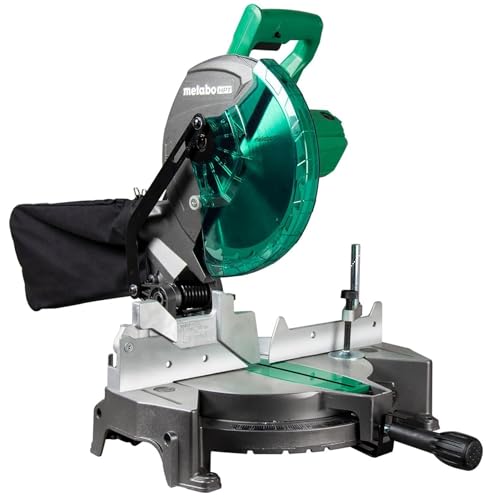
1. Metabo HPT C10FCGS 10-Inch Compound Miter Saw — 24.2 lbs
The C10FCGS is the lightest saw in this guide by a clear margin, and Metabo HPT builds its whole pitch around that figure: the maker’s page leads with a weight of 24.2 pounds for this 10-inch compound saw. The motor is a 15-amp unit with a no-load speed of 5,000 RPM, so the low weight does not come from a smaller power class. The miter range runs from 0 to 52 degrees in both directions, the widest swing here, with positive stops at 0, 15, 22.5, 31.6 and 45 degrees on both sides. The bevel tilts from 0 to 45 degrees to the left. An electric brake stops the blade promptly when the trigger is released, the blade is a 10-inch with a 5/8-inch arbor, and the tool carries a five-year warranty, the longest term in this group.
This is the saw for anyone who carries a miter saw most days: flooring installers working in occupied homes, trim carpenters moving room to room, and DIY users who store the saw on a shelf and lift it down for each project. At 24.2 pounds it is a comfortable one-person lift onto a stand or a tailgate.
The limits follow from the format. The bevel goes left only, so matched crown pieces mean flipping the stock. There is no slide, so crosscut width is whatever the 10-inch blade covers in one plunge. The included blade is a 24-tooth carbide type, a framing-grade tooth count that leaves a rougher edge on painted trim; a finer blade is the natural companion purchase for finish work.
2. Makita LS1040 10-Inch Compound Miter Saw — 27.3 lbs
Makita’s LS1040 has been the reference point for a light 10-inch saw for years, and the maker’s spec sheet puts its net weight at 27.3 pounds. Its 15-amp motor is a direct drive design, which does away with a drive belt to service, and it turns the blade at 4,600 RPM. The miter range runs 0 to 45 degrees to the left and 0 to 52 degrees to the right, with nine positive stops. The bevel reaches 45 degrees to the left. Makita states a maximum cutting capacity of 2-3/4 by 5-1/8 inches at a 90-degree miter, and 1-3/8 by 3-5/8 inches at a 45-degree miter. The base is machined aluminum, a fluorescent lamp lights the work surface, and the box includes a 40-tooth micro-polished blade, a vertical vise, a dust bag, a triangular rule and a socket wrench.
That included blade is the detail that sets this saw apart for finish work: a 40-tooth micro-polished blade is a trim blade, not a framing blade, so the saw is ready for casing and baseboard as it arrives. Makita positions the LS1040 at finish carpenters, cabinet installers and deck builders, and the spec sheet backs that up.
The trade-offs are a single left-hand bevel, no sliding head, and a one-year warranty, the shortest here. Its 4,600 RPM top speed is also the lowest figure in this group on paper, though in softwood and trim stock the direct drive motor holds its speed well by design. Nothing here cuts wider than 5-1/8 inches in one pass, so wide boards still belong on a sliding saw.
3. Milwaukee M18 FUEL 2733-20 7-1/4-Inch Dual Bevel Sliding Compound Miter Saw — 28 lbs with battery

The 2733-20 is the only cordless saw in this guide and the only one that slides or bevels both ways. Milwaukee states its weight as 28 pounds with a battery fitted and calls it the lightest saw in its class on that basis. The brushless motor runs on the M18 battery system, and Milwaukee credits it with over 600 cuts per charge when paired with an XC5.0 pack. Capacity is stated as a 2×8 lying flat at 90 degrees, 3-1/2 inches of vertical capacity against the fence, and 3-5/8 inches for crown molding nested in the fence. The dual bevel has stops at 45 and 48 degrees, the miter detent system locks with a cam action, a shadow cut line indicator marks the cut, and carry handles are built into the top and sides. The tool ships with a carbide-tipped blade, a clamp and a blade wrench; the battery and charger are supplied separately.
For a carpenter or remodeler already carrying M18 batteries, this is the pick that removes the cord from room-to-room work entirely, and the dual bevel earns its place on crown and casing, where the workpiece stays put for both halves of a corner. The nested crown figure is the best in this group despite the smallest blade.
The honest caveats: a 7-1/4-inch blade gives the shallowest cut here, so thick stock is out, and the 28-pound figure includes a battery while the three corded figures do not, which flatters the comparison slightly. Runtime claims rest on the maker’s own test setup with a 5.0-amp-hour pack, so a full day of cutting means owning more than one pack.
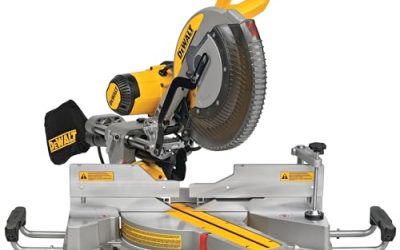
4. DEWALT DWS713 10-Inch Single Bevel Compound Miter Saw — 31 lbs

The DWS713 is the heaviest saw in this guide at 31 pounds on DEWALT’s published figure, and it spends that weight on capacity and detent hardware. The 15-amp motor runs at 5,000 RPM. The miter range covers 0 to 50 degrees in both directions with 14 positive stops on a stainless-steel detent plate, the highest stop count here. The bevel runs from 0 to 48 degrees to the left and 0 to 3 degrees to the right. DEWALT rates the crosscut at a 2×6 at 90 degrees and a 2×4 at 45 degrees, and the tall sliding fence supports baseboard up to 4-1/4 inches high standing vertically against it, the tallest fence figure in this group. An automatic electric brake and a built-in carry handle round out the spec.
This is the pick for trim work where baseboard height is the deciding job: the tall fence and the 14-stop plate suit casing, base and shoe molding repeated across a whole house, and the saw is still light enough for one person to carry between rooms and floors.
It gives up the slide, so a 2×6 is the widest crosscut at 90 degrees, and the three degrees of right bevel is a clearance allowance rather than a working range, which puts it in the same flip-the-stock camp as the other corded saws. At 31 pounds it is also the one you will notice most on a long carry from the vehicle.
Comparison Table
| Saw | Maker-stated weight | Blade | Power | Bevel | Miter range | Cut-line aid |
|---|---|---|---|---|---|---|
| Metabo HPT C10FCGS | 24.2 lbs | 10 in | 15 amp corded | 0–45° left | 0–52° left and right | None stated |
| Makita LS1040 | 27.3 lbs | 10 in | 15 amp corded | 0–45° left | 0–45° left, 0–52° right | Fluorescent work lamp |
| Milwaukee M18 FUEL 2733-20 | 28 lbs with battery | 7-1/4 in | 18V cordless, tool only | Dual, stops at 45° and 48° | Cam-lock detent system | Shadow cut line |
| DEWALT DWS713 | 31 lbs | 10 in | 15 amp corded | 0–48° left, 0–3° right | 0–50° left and right | None stated |
Frequently Asked Questions
What weight counts as a lightweight miter saw?
There is no industry cutoff. This guide draws the line at 31 pounds using each maker’s published figure, a range one person can lift onto a stand and carry up stairs repeatedly through a day. Full-size 12-inch sliding saws sit far above that line, which is why none appears here.
Can a 7-1/4-inch saw handle baseboard and crown molding?
Within limits, yes. Milwaukee states 3-1/2 inches of vertical capacity against the fence and 3-5/8 inches for nested crown on the 2733-20, which covers common baseboard and smaller crown profiles. Taller baseboard belongs on a 10-inch saw; the DEWALT DWS713 holds stock up to 4-1/4 inches high against its fence.
Is corded or cordless better for moving from room to room?
Cordless removes cord handling and outlet hunting, and the Milwaukee here weighs no more than the corded Makita. Corded saws never wait on a battery and their published weights need no pack added. If you already own batteries in a system, the cordless saw that matches it is usually the practical choice; if not, a corded saw is the simpler kit.
How much capacity does a fixed head give up against a sliding head?
A fixed 10-inch head crosscuts up to about five to six inches of width depending on the model: Makita states 5-1/8 inches at 90 degrees, and DEWALT rates its saw for a 2×6. The sliding 7-1/4-inch Milwaukee reaches a 2×8 lying flat. The slide buys width, not depth, so the exchange favors wide, thin stock such as flooring and shelving.
Which included blade suits painted trim?
The Makita LS1040 ships with a 40-tooth micro-polished blade, the finest tooth count in the box among these four. The Metabo HPT ships with a 24-tooth blade, a framing pattern that cuts fast and leaves a rougher edge. For painted trim on any of these saws, a higher tooth count blade is the upgrade that shows in the finish.
Conclusion
Ranked purely by the scale, the Metabo HPT C10FCGS stands alone: 24.2 pounds, a full 15-amp motor, the widest miter swing here and a five-year warranty. The Makita LS1040 is the finish carpenter’s version of the same idea, a little heavier, with the best included blade and a direct drive motor. The Milwaukee 2733-20 is the pick when the cord itself is the burden, adding a slide and a dual bevel at 28 pounds with a battery aboard. The DEWALT DWS713 trades a few pounds for the tallest fence and the most detent stops, which is the right exchange for whole-house trim work. Choose by the carry you actually face and the tallest stock you cut, and every saw on this list will spare your shoulder compared with a full-size machine.