Key takeaways
- We compare five santoku knives for daily prep, from a budget forged blade to a handcrafted Japanese Damascus pick, so you can choose the right edge.
A santoku is the Japanese answer to the everyday kitchen knife. Its name means three virtues: slicing, dicing, and mincing. Compared with a Western chef knife, a santoku runs shorter, carries a flatter edge, and ends in a rounded sheepfoot tip instead of a sharp point. That shape suits straight-down push cuts and fast vegetable prep.
This guide covers santoku knives only. You will not find chef knives, nakiri blades, or paring knives here, because each of those shapes answers a different question. Every pick below is a true santoku with a wide blade and a flat cutting edge.
As an Amazon Associate, we earn from qualifying purchases.
Quick Answer
For most home cooks, the Mercer Culinary Genesis 7-inch santoku is the best starting point: a forged blade, a secure grip, and a shape that handles daily vegetables, herbs, and boneless meat with ease. If you want Japanese steel, the Shun Classic is the premium step up, while the Victorinox Fibrox suits first-time buyers.
How to Choose
Start with blade length. Most santoku knives measure 7 inches, which covers a full onion and a large sweet potato without feeling unwieldy. A 6.5-inch blade suits smaller boards, while a 5-inch santoku works as a compact second knife.
Next, look at the edge. A plain edge slices cleanly and sharpens easily, which makes it the default choice. A Granton edge has shallow scallops that help wet slices such as cucumber release from the steel instead of clinging. The scallops do not make the knife sharper, but they make repetitive slicing less fiddly.
Steel trades edge life against toughness. Harder steel holds a fine edge longer yet chips more easily on bone, frozen food, and hard seeds. Softer steel dulls sooner but forgives rough handling and sharpens with less effort. The German blades here sit near the middle; the Japanese pick runs harder.
Handle comfort decides whether a knife becomes your daily tool or gathers dust. Hold it in a pinch grip, with thumb and forefinger on the blade just ahead of the handle, and check that the balance point sits near the bolster. A handle that feels secure when wet is worth more than a pretty one. Full tang construction adds balance and durability.
Finally, think about care. Every santoku here performs best with hand washing and a wooden or soft plastic board. Dishwashers dull edges and loosen handles, and glass or stone boards chip hard steel. A honing rod keeps a softer blade aligned, while a harder Japanese blade benefits from a whetstone or a professional service.
Mercer Culinary Genesis 7-Inch Santoku Knife

The Mercer Culinary Genesis is the workhorse of this guide, and the pick we suggest first to cooks who want one santoku that simply does the job. Mercer forges the blade from high-carbon German steel and sharpens it to a 15-degree edge, finer than most Western knives. The result bites into onions and tomatoes with little pressure.
The Santoprene handle stays tacky when wet, which matters when hands get damp from washing produce. Three rivets anchor the full tang, and the bolster keeps the knife stable in a pinch grip.
It is also the most forgiving forged santoku in the group: the moderate-hardness steel sharpens easily and resists chipping on a stray chicken bone or hard squash. One honest note: this knife sells out often on Amazon, so availability can vary. If it is out of stock, the Victorinox below is the closest fallback.
Specs
| Feature | Detail |
|---|---|
| Blade length | 7 inches |
| Blade steel | High-carbon German steel |
| Edge | Plain, 15 degrees |
| Hardness | 56 Rockwell |
| Handle | Santoprene, triple rivet, full tang |
| Care | Hand wash, hone often |
Victorinox Fibrox 7-Inch Granton Edge Santoku Knife
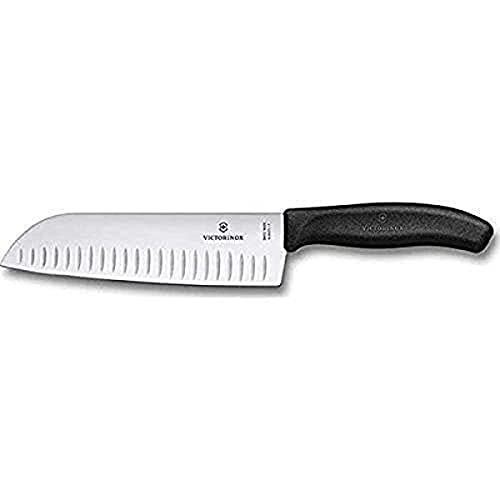
The Victorinox Fibrox is the easiest santoku here to pick up and use well on day one. Its textured Fibrox handle is the most secure grip in this guide, shaped to sit naturally in the hand and nearly impossible to lose hold of when wet. For a first real knife, that confidence matters more than steel.
The blade carries a Granton edge, with shallow scallops that help slices of potato, cucumber, and tomato fall away instead of sticking. The softer stainless steel sharpens with little effort and shrugs off the occasional knock against a plate or a bone.
One detail worth stating plainly: Victorinox lists this blade at 6.7 inches, while retailers sell it as a 7-inch knife. The difference is small, and the blade covers the same jobs as its rivals, but the measurement comes from the maker rather than the shelf label. It is also lighter than the forged options.
Specs
| Feature | Detail |
|---|---|
| Blade length | 6.7 inches per maker, sold as 7 inches |
| Blade steel | High-carbon stainless steel |
| Edge | Granton, hollow ground |
| Handle | Fibrox, textured, slip resistant |
| Weight | Light, easy to control |
| Care | Hand wash recommended, dishwasher safe per maker |
Wusthof Classic 7-Inch Hollow Edge Santoku Knife

The Wusthof Classic is the premium German pick here, forged in Solingen from a single piece of high-carbon stainless steel. Its full tang and triple-riveted handle give it a solid, balanced feel, and the 58 Rockwell hardness holds an edge noticeably longer than the softer blades. If you cook most nights and want a santoku that feels like a long-term tool, this is the one to consider.
The hollow edge is the defining feature. Oval scallops reduce friction and help food release, which matters when you are slicing a pile of potatoes or cucumbers for a crowd. The wide blade also scoops chopped herbs from the board, and the flat edge suits the straight-down push cut santoku knives are built for.
A stock note is due here. The latest tracker capture for this listing showed third-party new offers but no current direct Amazon offer, so availability may depend on the seller when you check. Confirm the seller and listing details before ordering, and treat this as the pick to click-check first.
Specs
| Feature | Detail |
|---|---|
| Blade length | 7 inches |
| Blade steel | High-carbon stainless steel |
| Edge | Hollow edge, Granton scallops |
| Hardness | 58 Rockwell |
| Handle | Triple rivet, full tang, full bolster |
| Made in | Solingen, Germany |
Shun Classic 7-Inch Santoku Knife DM0702

The Shun Classic is the Japanese heart of this guide, handcrafted in Japan around a VG-MAX steel core wrapped in Damascus cladding. The blade arrives with a 16-degree edge per side, finer than any other pick here, and it glides through vegetables, fish, and boneless meat. The D-shaped Pakkawood handle suits both right and left hands, and the Damascus pattern gives the blade a look no other knife here can match.
Shun backs the knife with free sharpening and honing for life, a genuine perk for cooks who do not sharpen at home. The hard steel holds its edge longer between sharpenings than the German blades, and the flat profile excels at paper-thin onion and cucumber slices.
Two honest notes belong here. First, Shun’s own pages state the Damascus layer count inconsistently, with 68 and 69 layers both appearing, so we do not assert a specific number. Second, this DM0702 model has a plain edge, while its sibling DM0718 carries the hollow-ground edge; the two are separate listings, so check the model number before ordering. The hard steel can also chip on bone, frozen food, or a glass board.
Specs
| Feature | Detail |
|---|---|
| Blade length | 7 inches |
| Blade steel | VG-MAX core, Damascus cladding |
| Edge | Plain, 16 degrees per side |
| Handle | D-shaped Pakkawood |
| Made in | Japan, handcrafted |
| Care | Hand wash only, free factory sharpening |
Babish 6.5-Inch Santoku Knife

The Babish santoku is the compact pick here, and it earns its place for smaller kitchens and smaller boards. At 6.5 inches, the blade turns quickly around a crowded cutting board and feels nimble when you are mincing garlic or slicing a tomato for one sandwich. Cooks with smaller hands often prefer this length, and it stores easily in a drawer or a knife roll.
The blade is forged from a single piece of high-carbon 1.4116 German steel, the same family used in many professional kitchen knives, and it carries a Granton edge that helps wet slices release. The full tang and black handle give it a sturdy, balanced feel that belies its size.
This is the most affordable forged-feeling knife in the group, a smart way to learn whether the santoku shape suits your cooking before committing to a premium blade. The trade is reach: a 6.5-inch blade will not span a large cabbage as comfortably as a 7-inch blade, so cooks who prep large vegetables in volume may prefer a longer pick. For everyday meals in a small kitchen, this santoku covers 4 of 5 common prep jobs without fuss.
Specs
| Feature | Detail |
|---|---|
| Blade length | 6.5 inches |
| Blade steel | High-carbon 1.4116 German steel |
| Edge | Granton, hollow ground |
| Handle | Full tang, black |
| Build | Forged, single piece |
| Care | Hand wash recommended |
Who Should Skip It
A santoku is not the right knife for every cook. If you rock-chop with a rolling motion, a chef knife with a curved edge will suit you better, because the santoku’s flat edge is built for straight-down push cuts. If you often need a pointed tip for scoring or trimming around bones, the rounded sheepfoot tip will frustrate you.
Heavy-duty jobs also belong elsewhere. A santoku should never meet bones, frozen food, hard squash rinds, or a glass cutting board, especially the harder Japanese blades, which can chip. Anyone who breaks down whole poultry regularly will do better with a boning blade.
Very large hands can also struggle with a santoku, since the shorter blade and compact handle leave less room for a full grip. Cooks who want a single knife for every job, from carving a roast to slicing bread, will find the santoku too narrow in scope. And if you insist on dishwasher cleaning, skip the premium picks here entirely.
FAQ
What is a santoku knife used for?
A santoku handles the three jobs in its name: slicing, dicing, and mincing. It excels at vegetables, herbs, fish, and boneless meat, using straight-down push cuts on a flat board.
How is a santoku different from a chef knife?
A santoku is shorter, usually 7 inches against 8 inches for a chef knife, with a flatter edge and a rounded sheepfoot tip instead of a pointed one. Chef knives suit rocking cuts and piercing tasks, while santoku knives suit push cuts and precise vegetable work.
What size santoku should I buy?
Most cooks should choose a 7-inch santoku, which covers a full onion and a large sweet potato without feeling unwieldy. A 6.5-inch blade suits smaller boards and smaller hands, while a 5-inch santoku works as a compact second knife.
How do I sharpen a santoku knife?
Hone a softer German blade with a honing rod before most uses, and sharpen it on a whetstone when honing no longer restores the edge. A harder Japanese blade needs a whetstone or a professional service.
Final Verdict
The Mercer Culinary Genesis 7-inch santoku is the best choice for most home cooks, because it pairs a forged blade with a secure grip and a shape that handles daily prep without drama.
If you want the finest cutting experience here, step up to the Shun Classic DM0702, with its VG-MAX core and handcrafted Japanese build, and accept the gentler care it asks for. If you are buying your first real knife, the Victorinox Fibrox gives you the most forgiving grip. The Wusthof Classic suits cooks who want a premium German blade built to last decades, and the Babish 6.5-inch is the smart compact pick for small kitchens.
Product and ASIN Reference
| Product | ASIN |
|---|---|
| Mercer Culinary Genesis 7-Inch Santoku Knife | B000IBVD4I |
| Victorinox Fibrox 7-Inch Granton Edge Santoku Knife | B000QCPNWM |
| Wusthof Classic 7-Inch Hollow Edge Santoku Knife | B00005MEGX |
| Shun Classic 7-Inch Santoku Knife DM0702 | B0000Y7KFO |
| Babish 6.5-Inch Santoku Knife | B08WJRBL8Q |