Key takeaways
- Discover the best donabe pots for rice, hot pot and steaming, from Iga and Banko ware rice cookers to family nabe pots, with sizing and care tips.
A donabe is a Japanese earthenware pot made to cook over direct heat and then travel straight to the table, still gently bubbling. The thick clay heats slowly, holds warmth long after the burner is off, and gives rice a soft, distinct texture and hot pot broths a rounded, simmered depth that thin metal rarely matches. The best donabe pots fall into clear families: double-lidded rice cookers, wide shallow nabe pots for shared hot pot, and small single-serve pots for soups, porridge, and solo meals.
As an Amazon Associate, we earn from qualifying purchases.
Quick Answer
For most cooks, start with a dedicated rice donabe such as the Nagatani Seitou Kamado-san or the IPPINKA 3 Go rice cooker for fluffy everyday rice, then add a wide floral or TIKUSAN nabe pot if you host hot pot nights. Solo cooks should choose the compact Mishima single-serve pot. Match capacity to household size first, then check gas compatibility and lid style.
How to Choose
Start with the job. Rice donabe are taller with a heavy double lid. The inner lid adds gentle pressure and limits boil-over, which helps grains cook evenly without constant watching. General nabe pots are wider and shallower, with a single domed lid and two side handles. That shape leaves room for arranging vegetables, tofu, seafood, and thinly sliced meat around a shared broth, and it makes serving at the table easier. Steamer-style and deep pots sit between the two, useful for porridge, stews, and steamed vegetables.
Next, size honestly. Japanese sizing often uses go for rice, where one go is one rice-cup measure, and liters or fluid ounces for nabe volume. A 2 to 3 go rice pot suits one to three people for daily rice. A 5 go model suits a family that cooks rice in larger batches or wants leftovers for fried rice and lunch boxes. For hot pot, a pot around 3 liters serves three to five people comfortably, while a pot under 1 liter is truly a single-serve piece for one person eating alone.
Check your heat source before anything else. Most traditional donabe are made for gas flame. The clay, especially Banko ware from Mie Prefecture blended for heat resistance, is designed to sit over an open burner and to go into an oven or microwave in many cases, but it is not automatically induction compatible. Only choose a donabe for induction if the listing explicitly names induction compatibility and a fitted metal plate or induction-ready base. Electric coil and glass tops vary by maker, so confirm the listing for your exact stove type rather than assuming.
Consider clay origin. Iga ware is known for coarse, porous clay that stores heat well. Banko ware, or Banko-yaki, is known for heat-resistant clay that tolerates direct flame. A named kiln tradition, made in Japan origin, and clear care instructions are stronger signals than a generic label with no maker information.
Think about lids and care together. A double lid suits rice, a single vented lid suits nabe where you add ingredients in stages. Look for sturdy handles and a footprint that fits your burner. Donabe need seasoning before first use, gradual heating, and full air drying before storage to prevent mold in the porous clay.
Nagatani Seitou Kamado-san ACT-50 Rice Donabe
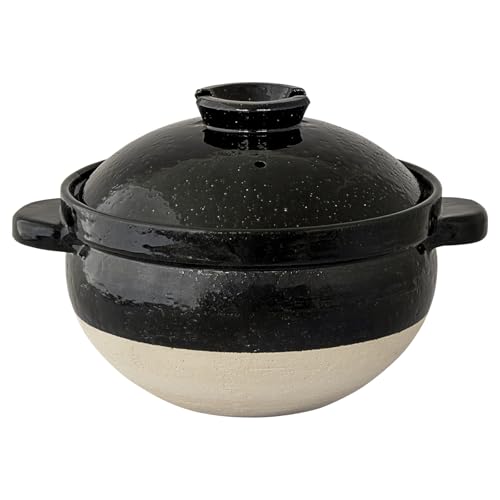
The Kamado-san is the reference point for stovetop rice donabe, made in Japan by Nagatani Seitou in the Iga ware tradition. This ACT-50 version is sized for 5 go of rice, with a capacity of about 2500 milliliters, and it arrives with a rice spoon and recipe guidance. The form is tall and rounded, built around rice rather than general simmering, and the black finish keeps the focus on function.
The double-lid system is the reason to choose it. The inner lid helps control moisture and pressure as the rice cooks over gas, supporting separate, glossy grains with a tender center. Cooks who make Japanese short-grain rice several times a week, or who want a pot that can also handle mixed rice, takikomi dishes, and porridge with the same lid system, will get the most from this design. The clay body retains heat well, so rice stays warm at the table without a separate warmer.
Trade-offs are size and specialization. At about 10.2 inches across and 8.5 inches tall, it needs storage space, and it is not the wide shape you want for shabu-shabu for a group. Treat it as a dedicated rice cooker. If you cook rice only once a month, a smaller pot below is a better use of space.
Specs
| Spec | Detail |
|---|---|
| Brand | Nagatani Seitou |
| Model | ACT-50 Kamado-san |
| Capacity | 2500 milliliters, 5 go rice |
| Dimensions | 10.2 x 8.5 inches |
| Color | Black |
| Origin | Made in Japan |
| Includes | Rice spoon and recipe |
IPPINKA Japanese Donabe Rice Cooker 3 Go

The IPPINKA 3 Go rice cooker is a Banko-yaki donabe made in Mie, Japan, sized for smaller households that still want a dedicated rice pot. With a 1900 milliliter capacity and an inner lid, it cooks about 3 go of rice, which suits one to three people for a main meal, or a couple that cooks rice daily without large leftovers.
The rounded bottom helps flame wrap the base for even heat, and interior water lines help measure the rice to water ratio. It also suits brown rice and mixed rice, where clay moisture retention helps longer-cooking grains finish tender. At 5.39 pounds with a 7.6 by 8.8 by 6.7 inch footprint, it fits most burners and cupboards. Choose it for double-lid rice in a right-sized format; skip it if you regularly cook for five or more people.
Specs
| Spec | Detail |
|---|---|
| Brand | IPPINKA |
| Type | Banko-yaki rice donabe |
| Capacity | 1900 milliliters, 3 go rice |
| Dimensions | 7.6 x 8.8 x 6.7 inches |
| Weight | 5.39 pounds |
| Color | Black |
| Origin | Made in Mie, Japan |
IPPINKA Authentic Japanese Cooking Donabe Floral

This IPPINKA donabe is the classic wide nabe pot in this guide, made for shared hot pot rather than rice alone. It holds 3200 milliliters, measures about 12.2 by 11 by 6.5 inches, and is sized for four to five people. The natural floral design and painted finish make it a genuine cook-and-serve piece, meant to sit in the center of the table while everyone cooks and eats together.
The shallow, broad shape is the point. Broth simmers across a wide surface, ingredients can be arranged in sections, and diners can reach everything without crowding. It also works for stews and noodle soups outside hot pot season. At 6 pounds, it is a gathering pot, not a solo lunch pot, and it needs stable, centered heat. For households that host nabe nights and sukiyaki, this is the most social pick on the list.
Specs
| Spec | Detail |
|---|---|
| Brand | IPPINKA |
| Type | Banko-yaki nabe hot pot |
| Capacity | 3200 milliliters |
| Dimensions | 12.2 x 11 x 6.5 inches |
| Weight | 6 pounds |
| Serves | 4 to 5 people |
| Origin | Made in Japan |
TIKUSAN Donabe Japanese Hot Pot Banko Ware 9 Go

The TIKUSAN donabe is another Banko ware hot pot from Japan, in the large 9 go size with a 108 fluid ounce capacity. That puts it in the same family hosting role as the floral IPPINKA pot, but with a simpler, warmer presentation and a focus on versatility across cooking, steaming, and simmering.
Use it for classic nabe, simmered vegetables and fish, and hearty soups that benefit from clay heat retention. The round pottery body keeps food warm at the table for meals eaten in stages. The listing notes oven and stovetop suitability. At 3.17 kilograms it is heavy by design, storing heat in thick walls, so lifting and washing need two hands. Choose it for regular family use; choose smaller if you mostly cook for one or two.
Specs
| Spec | Detail |
|---|---|
| Brand | TIKUSAN |
| Model | TO-215512 |
| Capacity | 108 fluid ounces, 9 go size |
| Weight | 3.17 kilograms |
| Material | Pottery, Banko ware |
| Stovetop | Suitable for stovetop use |
| Origin | Made in Japan |
IPPINKA Banko Ware Mishima Donabe Pot for 1 Person
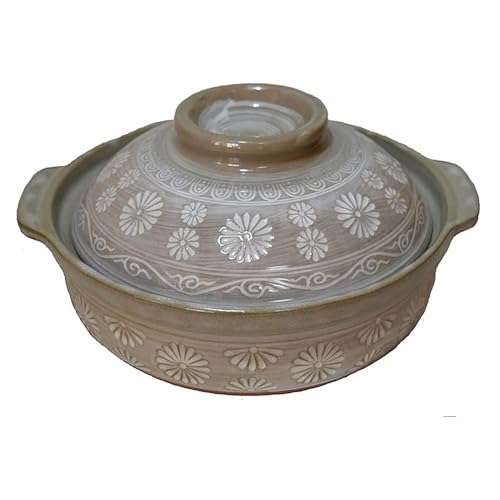
The Mishima donabe from IPPINKA solves the opposite problem from the family pots above: how to enjoy donabe cooking when you live alone, cook for one, or want a personal pot for lunch or a quiet evening meal. It holds 0.9 liters, weighs about 2.2 pounds, and carries the stamped Mishima floral pattern associated with Banko ware hot pots, scaled down to a single serving.
That size is ideal for personal hot pot, miso soup, rice porridge, and single portions of rice or noodles. The listing describes a water-repellent coating to reduce sticking and notes oven, microwave, and dishwasher suitability, making this the lowest-friction donabe on the list. It heats quickly, stores easily, and lets a beginner learn donabe care without a large pot. It will not feed a group, but as a personal pot it is the most accessible entry point here.
Specs
| Spec | Detail |
|---|---|
| Brand | IPPINKA |
| Type | Banko ware Mishima donabe |
| Capacity | 0.9 liters |
| Weight | 2.2 pounds |
| Serves | 1 person |
| Care | Oven, microwave, dishwasher noted |
| Origin | Made in Japan |
Who Should Skip It
Skip donabe if your kitchen is induction only and you cannot confirm an induction-ready model, since most traditional clay donabe are gas-first designs. Skip it if you want cookware you can heat empty, blast on high, soak indefinitely, or toss in a crowded dishwasher without thought, because porous clay rewards slower, more deliberate habits. Skip it if you dislike seasoning and fully drying a pot before storage.
You should also skip a large family nabe pot if you cook only for yourself, and skip a tiny single-serve pot if your real goal is weekend hot pot for friends. Finally, if you mainly want set-and-forget rice while you leave the kitchen, an electric rice cooker remains the more practical tool. Donabe shine when you enjoy staying near the pot and serving from it.
FAQ
Do donabe pots work on induction cooktops?
Most traditional donabe do not work on induction unless the specific model is explicitly made for it with an induction-compatible base. The clay itself does not respond to induction. Always check the individual listing for your heat source, and default to gas for classic Iga and Banko ware pots unless induction use is clearly stated by the maker or seller.
How do you season a donabe before first use?
Seasoning usually means simmering starchy water, such as rice rinsing water or water with a little wheat flour or rice porridge, on low to medium heat, then letting the pot cool completely before washing. This helps seal the pores of the clay and reduces leaking and cracking. Follow the instructions supplied with your specific pot, since timing varies by maker.
Can a donabe go in the oven?
Many donabe can go in the oven, and several listings in this guide note oven suitability, but you should avoid sudden temperature changes. Let the pot warm and cool gradually, never move it directly from cold storage to a hot oven or flame, and confirm the limit for your exact model in its listing and care guide before using oven heat.
What is the difference between a rice donabe and a nabe pot?
A rice donabe is taller, with a heavy double lid that controls pressure and moisture for grains. A nabe pot is wider and shallower, with a single lid, made for shared broth dishes where ingredients are added and served at the table. Some pots can cross over for soups and stews, but choosing the shape for your main dish gives the best results.
Final Verdict
The best donabe pots are not interchangeable, and that is their strength. Choose the Nagatani Seitou Kamado-san for serious, larger-batch rice, the IPPINKA 3 Go for everyday rice in a smaller home, the IPPINKA floral pot or the TIKUSAN 9 go for shared hot pot, and the Mishima single-serve pot for solo soups and porridge. Buy the size and shape for the meal you actually cook most, confirm gas compatibility, season it once with care, and a good donabe will serve your table for years.
Product and ASIN Reference
| Product | ASIN |
|---|---|
| Nagatani Seitou Kamado-san ACT-50 Rice Donabe | B0BCTVJ9BY |
| IPPINKA Japanese Donabe Rice Cooker 3 Go | B08DRRPQ12 |
| IPPINKA Authentic Japanese Cooking Donabe Floral | B07C3FJ4NY |
| TIKUSAN Donabe Japanese Hot Pot Banko Ware 9 Go | B0CM8JXBCG |
| IPPINKA Banko Ware Mishima Donabe Pot for 1 Person | B095J19YJX |