Key takeaways
- Compare the best herb strippers for kale, rosemary, and thyme, with hole counts, materials, and bowl designs to speed up everyday herb prep.
Picking leaves off rosemary, thyme, and kale stems by hand is one of those small kitchen jobs that quietly eats up prep time. A bunch of kale can take several minutes to destem with your fingers, and woody herbs like rosemary resist pinching and scatter needles across the counter. An herb stripper solves the problem with a simple idea: a row of sized holes or slots that grip the stem while the leaves stay behind as you pull.
These tools come in a few distinct shapes. Flat stainless steel cards carry eight or nine graduated holes and often add a curved cutting edge for trimming larger leaves. Leaf-shaped metal tools focus on a comfortable grip and a flat side for gathering leaves. Bowl-style strippers catch the leaves as they come off the stem and sometimes add measurement markings for recipes that specify an amount of loose herbs.
This guide compares five stripping tools only. It does not cover herb storage containers, herb savers, scissors, or mills, because those solve different problems. Every pick is a dedicated stripper with sized holes, for jobs from a few sprigs of thyme to a bunch of collard greens.
As an Amazon Associate, we earn from qualifying purchases.
Quick Answer
For most cooks, a flat stainless steel stripper with eight or nine graduated holes handles the widest range of stems, from thin thyme to thick kale ribs. Choose the DOMG tool for thick, rigid metal, the Jiaedge for a protective cover and cutting edge, or the Chef’n Zipstrip when a built-in collecting bowl and measurements matter more than hole count.
How to Choose
Start with the stems you strip most often. Fine, flexible stems such as thyme, oregano, and tarragon need small holes that grip without snapping the stem. Woody stems such as rosemary need a snug mid-size hole and a body rigid enough to take a firm pull. Leafy greens are a different job: kale, chard, and collard stems are thick and tapered, so they need the largest holes, and a curved edge helps trim the leaf from the rib. A wide spread of hole sizes covers all three jobs, while a four-hole bowl tool is aimed mainly at woody herbs.
Material decides how the tool ages. Stainless steel cards are thin, rigid, and easy to rinse clean, and thicker steel resists bending when you pull a stubborn kale rib through the largest hole. Look for food-grade steel and a stated thickness if you strip greens often. Plastic bowl strippers are lighter and add a collecting cup, but the holes can flex on thick stems, so they suit herbs better than heavy greens.
Consider how the leaves land. A flat card drops leaves onto the board, where the flat edge can sweep them into a pile. A bowl stripper catches leaves as they release, keeping small thyme leaves from scattering and letting you check the amount against measurement markings. If you strip directly over a pot, a flat card is simpler; if you measure loose herbs, the bowl design earns its space.
Check the edges before you buy. Many steel strippers add a curved cutting edge for slicing larger leaves and trimming stems. That edge is useful, but the tool should then be stored with a cover or in a tray rather than loose in a drawer, where it can dull against other utensils.
Finally, think about cleaning. Flat steel cards take almost no drawer space and most are dishwasher safe, though hand washing keeps cutting edges sharper. Bowl strippers take more room but rinse quickly. Dry steel tools before putting them away.
DOMG Herb Stripper Tool, Stainless Steel

The DOMG stripper is a flat stainless steel card built around thickness. The listing specifies 304 food-grade stainless steel at 2 mm thick, which matters when you pull a thick kale or collard stem through the largest hole: a thinner card can flex or deform, while this one is described as resisting deformation over long use. The shaped outline is designed for a comfortable grip at different angles, so you can hold the card over a bowl and pull stems downward.
The graduated holes cover the usual range for this class, from small openings for thyme and rosemary up to large openings for kale, chard, and collard greens, and the listing names exactly those plants. Because the body is a single piece of steel, there are no joints or coatings to wear out, and cleanup is a rinse or a dishwasher cycle.
This is the pick for cooks who strip greens as often as herbs and want the simplest, sturdiest format. It has no collecting bowl and no cover, so leaves land on the board. For a one-piece tool covering the full stem range without flexing, it is the most straightforward option here.
Specs
| Spec | Detail |
|---|---|
| Material | 304 food-grade stainless steel |
| Thickness | 2 mm |
| Holes | Graduated sizes for herbs and greens |
| Dishwasher safe | Yes |
| Item weight | 2.99 ounces |
| Package dimensions | 5.28 x 3.7 x 0.28 inches |
ropto Stainless Steel Leaf Herb Stripper Tool

The ropto stripper takes the leaf-shaped approach. Its stainless steel body carries eight different hole sizes and is shaped to sit comfortably in the hand while you pull stems through at whatever angle suits the bowl or board in front of you. The listing describes an insert-and-pull design: place the stem in the hole that matches its thickness, pull through, and the leaves come away in one motion.
The listing names kale, parsley, cilantro, thyme, rosemary, oregano, mustard greens, and collard greens, covering both soft-stemmed herbs and sturdy greens. The flat side doubles as a pusher for gathering stripped leaves into a pile, which helps when small leaves scatter across a cutting board.
At 7.3 inches long, this is the largest flat tool in the group, and the extra length gives more grip area for pulling thicker stems. One care note: the listing does not mark it dishwasher safe, so plan on a quick hand wash. Choose this one for a leaf-shaped grip, a gathering edge, and eight hole sizes in one steel tool.
Specs
| Spec | Detail |
|---|---|
| Material | Stainless steel |
| Holes | 8 sizes |
| Dimensions | 7.3 x 1.37 x 0.01 inches |
| Item weight | 5.3 ounces |
| Handle material | Stainless steel |
| Dishwasher safe | No, hand wash |
Chef’n Zipstrip Herb Stripper

The Chef’n Zipstrip is the bowl-style outlier in this group, and it solves a different annoyance: leaves scattering everywhere. Four sized holes sit in the handle of a small integrated bowl, so as you pull a stem through, the leaves collect inside the bowl instead of falling across the counter. The bowl doubles as a measuring cup, with markings for tablespoon amounts up to a quarter cup, plus milliliter equivalents.
The four holes are aimed at woody, stemmed herbs rather than big greens. The product description names rosemary, thyme, and tarragon, and the technique is to insert the stem root first into the closest-sized hole and pull through. With only four sizes, there is less range for thick kale ribs, so this is best understood as an herb specialist. The plastic body keeps it light at 1.44 ounces.
Care is simple: the Zipstrip is top-rack dishwasher safe. The trade-offs are the smaller hole count and plastic construction, which will not take the same pulling force as a thick steel card. Pick it if your stripping is mostly rosemary and thyme for recipes that call for measured amounts.
Specs
| Spec | Detail |
|---|---|
| Brand | Chef’n |
| Model | ZipStrip, 102-566-201 |
| Holes | 4 sizes |
| Bowl capacity markings | Tablespoon and milliliter measures |
| Dimensions | 3.74 x 2.51 x 3.08 inches |
| Item weight | 1.44 ounces |
| Dishwasher safe | Yes, top rack |
Jiaedge Herb Stripper, 9 Holes Stainless Steel
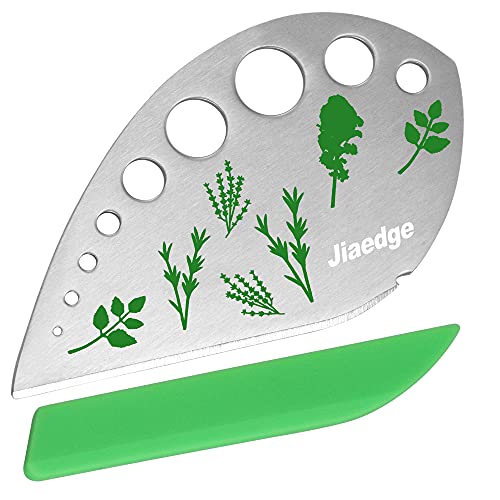
The Jiaedge stripper combines a nine-hole steel card with two practical extras: a cutting edge and a protective cover. The nine graduated holes cover most stems and leaves, and the listing names kale, collard greens, thyme, basil, and rosemary. The curved blade edge does more than strip: it can cut larger leaves down, which helps when breaking down chard or trimming greens.
The body is 2 mm thick stainless steel, matching the DOMG on rigidity, with a polypropylene handle area and a plastic protection cover for storage. That cover sets this pick apart for drawer storage, guarding both your fingers and the cutting edge. The listing describes the steel as food grade with rust and corrosion protection, and the footprint is compact at 4.8 by 2.7 inches.
At 2.39 ounces it is also the lightest steel card here. Choose it for nine holes, a trimming edge, and a cover that makes the tool safe in a utensil drawer.
Specs
| Spec | Detail |
|---|---|
| Material | Stainless steel with polypropylene handle |
| Holes | 9 sizes |
| Thickness | 2 mm |
| Dimensions | 4.8 x 2.7 inches |
| Item weight | 2.39 ounces |
| Extras | Cutting edge and protective cover |
Boorika Herb Stripper, 9-Hole Stainless Steel, 2 Pack

The Boorika listing is a two-pack of nine-hole stainless steel strippers, which changes the buying logic: you can keep one stripper with the cutting boards and another near the stove, or hand the second to a helper during big prep sessions. Each tool carries nine holes for stripping kale, rosemary, and basil, and the listing notes a cutting edge for trimming as you work.
The tools are stainless steel and dishwasher safe, so one can be in the dishwasher while the other stays in rotation, which suits households that cook with fresh herbs daily. Combined weight is 5 ounces, and the slim profile stores flat.
The honest limitation is information: the listing gives less detail on steel grade and thickness than the DOMG or Jiaedge listings, so if maximum rigidity for thick collard ribs is your priority, those picks state their specifications more clearly. Choose the Boorika pair for two strippers in two places.
Specs
| Spec | Detail |
|---|---|
| Material | Stainless steel |
| Holes | 9 per tool |
| Quantity | 2 strippers |
| Item weight | 5 ounces |
| Package dimensions | 3.7 x 1.26 x 0.55 inches |
| Dishwasher safe | Yes |
Who Should Skip It
Skip an herb stripper if you mostly use dried herbs, frozen herb cubes, or pre-chopped fresh herbs, because the tool only earns its drawer space when whole stems pass through your kitchen regularly. It is also a poor fit for delicate herbs in tiny amounts: a few basil leaves can be pinched off faster than you can find the right hole, and tender leaves can bruise when pulled through a snug opening.
Cooks who rarely strip greens should skip the large flat cards and the two-pack; a single small or bowl-style tool covers occasional use. Anyone expecting a stripper to chop, mince, or store herbs should look elsewhere, since these tools only remove leaves from stems. If your herb volume is low, your fingers and a cutting board already do this job.
FAQ
Which herbs work best with an herb stripper?
Woody and sturdy-stemmed herbs work best, including rosemary, thyme, oregano, and tarragon, along with leafy greens such as kale, chard, and collard greens. The stem needs enough firmness to be pulled through a hole without collapsing. Soft herbs like cilantro and parsley can be stripped with the larger holes, while delicate leaves are usually quicker to pinch off by hand.
How do I choose the right hole size for a stem?
Pick the smallest hole the stem slides into without forcing it. A hole that is too large lets leaves slip through with the stem, while one that is too small can snap the stem or shred the leaves. Pull steadily rather than yanking, and move down one size if leaves pass through or up one size if the stem keeps breaking.
Can an herb stripper damage delicate leaves?
It can bruise tender leaves if the hole is too tight or the pull is too fast. For delicate herbs, use the largest hole that still catches the leaves, pull slowly, and strip over a bowl so leaves fall a short distance. Herbs with very soft stems, such as basil, are often better pinched off by hand.
How should I clean and store a steel herb stripper?
Wash the tool soon after use so leaf residue does not dry inside the holes, then dry it fully before storing. Most steel models here are dishwasher safe, though hand washing protects cutting edges. Store edged models with their cover on or in a utensil tray.
Final Verdict
These five divide cleanly by style. For an all-purpose steel card that handles herbs and thick greens without flexing, the DOMG is the strongest default, with the Jiaedge close behind for anyone who wants a cutting edge and a storage cover. The ropto suits cooks who prefer a larger leaf-shaped grip and a gathering edge. The Chef’n Zipstrip is the herb specialist, catching and measuring leaves as you strip, while the Boorika two-pack suits busy kitchens that want a stripper in more than one spot. Match the hole range to the stems you cook with most.
Product and ASIN Reference
| Product | ASIN |
|---|---|
| DOMG Herb Stripper Tool, Stainless Steel | B08FJ19DG7 |
| ropto Stainless Steel Leaf Herb Stripper Tool | B07XBDF542 |
| Chef’n Zipstrip Herb Stripper | B07FT2FT3F |
| Jiaedge Herb Stripper, 9 Holes Stainless Steel | B08R6MPRZX |
| Boorika Herb Stripper, 9-Hole Stainless Steel, 2 Pack | B0F4NML4J5 |